Quick Answer
- You cannot make a car amplifier exceed its design, but most installed amplifiers deliver less than they can. Better voltage, thicker wiring and the right impedance load recover that power.
- Voltage matters most. A Rockford Fosgate P300X2 measured 238 watts at 12.0 volts and 398 watts at 14.4 volts (BestCarAudio, 2024).
- Thicker copper wire keeps voltage up. Over a 15-foot run, 8 AWG wire delivered 13.59 volts to the amplifier and 4 AWG delivered 14.08 volts (BestCarAudio, 2024).
- Lower impedance raises output: a Kicker CXA800.1 makes 300 watts at 4 ohms, 600 watts at 2 ohms and 800 watts at 1 ohm (Kicker, 2019).
- Turning up the gain or bass boost does not add power. Doubling power adds only 3 dB (BestCarAudio, 2025), so sometimes a second or larger amplifier is the real answer.
To make a car amplifier more powerful, give it more voltage and a load that lets it reach its full rating. That means thick copper power and ground wire, solid connections, a healthy charging system, speakers or subwoofers wired to the lowest impedance the amplifier is rated for, and gain set to the edge of clipping and no further. These changes do not raise the amplifier’s rating. They close the gap between what it can make and what it is making now.
Can You Make a Car Amplifier More Powerful?
You can raise what an amplifier delivers, up to its design limit. Most car amplifiers today use loosely regulated or unregulated power supplies, so their output follows the voltage they receive (BestCarAudio, 2024).
That is why the same amplifier makes different power in different cars. JL Audio rates its MX500/4 at 70 watts per channel into 4 ohms at 14.4 volts, and 55 watts per channel at 12.5 volts (JL Audio, 2026).
The limit is the hardware. Past its rated output, an amplifier clips, overheats or shuts down. Our explainer on how a car amplifier works covers the power supply that sets this ceiling.
| Change | What it gains | Limit |
|---|---|---|
| Thicker copper power and ground wire | Recovers lost voltage | Amplifier’s rating |
| Big 3 and charging upgrades | Holds voltage up under load | Alternator output |
| Lower impedance load | Up to double the power | Amplifier’s minimum impedance |
| Bridging two channels | 2 to 4 times one channel | Usually 4 ohms minimum |
| Correct gain | Full clean output | Clipping |
Step 1: Give the Amplifier More Voltage
Voltage at the amplifier’s terminals is the largest single factor. BestCarAudio measured a Rockford Fosgate P300X2 at five supply voltages (BestCarAudio, 2024):
| Supply voltage | Measured power |
|---|---|
| 11.25 V | About 190 watts |
| 12.0 V | 238 watts |
| 13.0 V | 286 watts |
| 14.0 V | 336 watts |
| 14.4 V | 398 watts |
The amplifier’s efficiency stayed at 67 to 68% throughout, so the gain came from voltage alone (BestCarAudio, 2024). In a separate test, one extra volt raised maximum power by 15 to 30% across several amplifiers (BestCarAudio, 2021).
Measure yours. With the engine running and music playing loudly, put a multimeter across the amplifier’s power and ground terminals. If you read well below what you see at the battery, the wiring is costing you power.
Step 2: Upgrade the Power and Ground Wire
Thin wire drops voltage before it reaches the amplifier. BestCarAudio calculated the voltage at the amplifier over a 15-foot run from a 14.4-volt battery (BestCarAudio, 2024):
| Wire gauge | Voltage at the amplifier |
|---|---|
| 10 AWG | 13.11 V |
| 8 AWG | 13.59 V |
| 4 AWG | 14.08 V |
| 1/0 AWG | 14.27 V |
By the same article’s figures, a 0.7-volt cable loss costs a 300-watt amplifier about 10% of its rated power, roughly 35 watts. BestCarAudio’s conclusion is that bigger power and ground cables are more cost-effective than buying the next-size amplifier (BestCarAudio, 2024). MTX’s advice is to use the largest gauge power wire that the amplifier’s input terminal is designed to accept (MTX Audio, 2026).
The metal matters too. Copper-clad aluminum (CCA) wire typically reaches 60 to 70% of the conductivity of solid copper (MWS Wire, 2025). BestCarAudio says a 4-gauge CCA wire performs closer to 6-gauge or 8-gauge copper, and gives an example where CCA cut a 1,000-watt amplifier to about 750 watts (BestCarAudio, 2026). If you already have CCA, Stinger advises going up a size (Stinger, 2026).
The ground has to match. Crutchfield notes that the main limit in most installations is current delivery, from a weak ground or insufficient wire gauge (Crutchfield, 2026). See our guide on how to ground an amplifier in a car for the ground point and how to test it, and how to install an amplifier in a car for sizing the power wire.
Step 3: Strengthen the Charging System
Once the wiring to the amplifier is right, the next limit is the car’s own electrical system. The first upgrade is the Big 3: replacing or adding to the alternator-to-battery positive wire, the battery ground to chassis, and the chassis to engine block wire with 1/0 or 4 gauge cable (Crutchfield, 2026). Kicker recommends the Big 3 at 1,000 watts (Kicker, 2026).
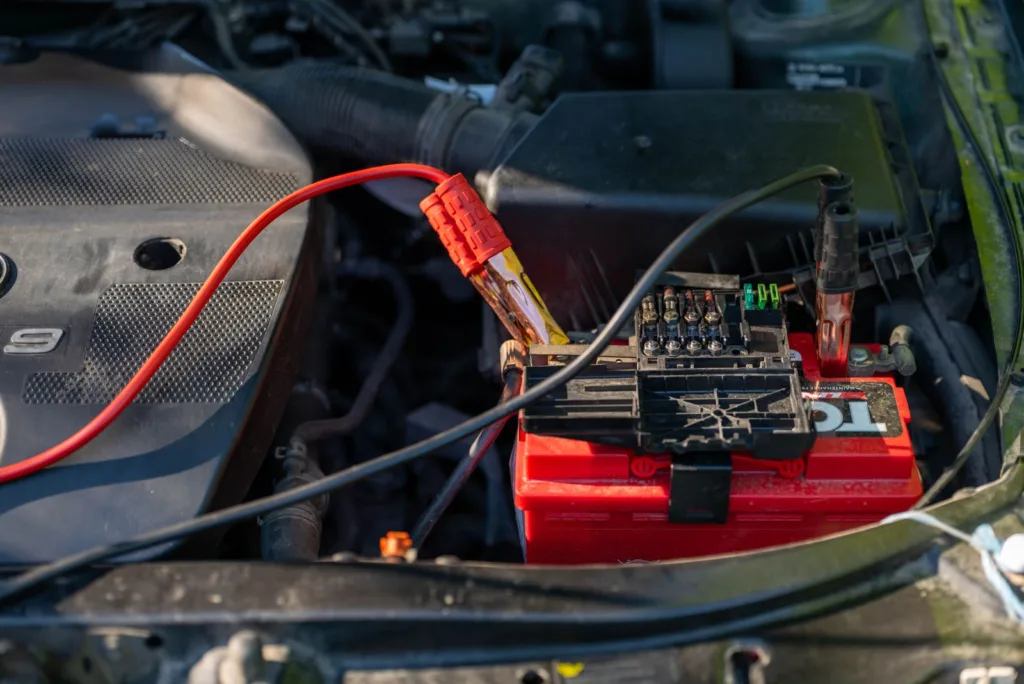
Crutchfield gives a way to check whether the alternator is enough: the maximum supportable wattage is about 11.7 times the alternator’s amp rating, so a 90-amp alternator supports up to 1,053 watts RMS and a 120-amp alternator up to 1,404 watts (Crutchfield, 2024).
| System size | Typical electrical upgrade |
|---|---|
| Under 1,000 W RMS | Rarely needs any (Crutchfield, 2026) |
| About 1,000 W RMS | Big 3 (Kicker, 2026) |
| 1,000 to 3,000 W RMS | Auxiliary AGM battery (DD Audio, 2018) |
| Over 2,000 W RMS | Usually a high-output alternator (Crutchfield, 2026) |
Capacitors are often sold as a power upgrade. Crutchfield is direct: a capacitor does not add power (Crutchfield, 2026). MTX explains that capacitors smooth brief current spikes but cannot make a system louder or replace an undersized alternator (MTX Audio, 2026).
Step 4: Wire the Speakers to a Lower Impedance
An amplifier makes more power into a lower impedance, if it is rated for that load. Crutchfield’s example is an amplifier that sends 100 watts into a 4-ohm speaker sending up to 200 watts into a 2-ohm speaker (Crutchfield, 2024).
Real amplifiers vary, so check the specifications:
| Load | Kicker CXA800.1 | Rockford Fosgate R2-1200X1 |
|---|---|---|
| 4 ohms | 300 W | 400 W |
| 2 ohms | 600 W | 800 W |
| 1 ohm | 800 W | 1,200 W |
These figures are from the manufacturers’ manuals (Kicker, 2019; Rockford Fosgate, 2019). Not every amplifier keeps gaining. Kicker’s CXA1200.1 makes 1,200 watts at 2 ohms and the same 1,200 watts at 1 ohm (Kicker, 2019).
Subwoofers with dual voice coils, or pairs of subwoofers, can be rewired in parallel to lower the load. Do not go below the amplifier’s minimum. Crutchfield notes that most car amplifiers handle a minimum of 2 ohms per channel, or 4 ohms bridged (Crutchfield, 2024). A lower load also makes more heat; our guide on how to keep a car amplifier cool explains how to manage it.
Step 5: Bridge a Multichannel Amplifier
Bridging combines two channels into one, and it is the quickest way to get more power from a 2-channel or 4-channel amplifier you already own. Crutchfield’s example is a 2-channel amplifier making 75 watts RMS per channel at 4 ohms that may make up to 200 watts RMS at 4 ohms bridged (Crutchfield, 2024).
Sound Certified puts the gain at 2 to 4 times the power of a single channel, depending on the design (Sound Certified, 2024). The reason is that bridging doubles the voltage across the speaker (BestCarAudio, 2020).
Two rules apply. The minimum impedance doubles, so a bridged pair usually needs a 4-ohm load. And a mono subwoofer amplifier cannot be bridged, because it has only one channel (Crutchfield, 2024). Two identical mono amplifiers with master and slave switching can be strapped together instead: BestCarAudio’s example is two 2,500-watt amplifiers delivering 5,000 watts into a 2-ohm minimum load (BestCarAudio, 2021).
Step 6: Set the Gain for Full Clean Output
Gain set too low leaves power unused, and gain set too high adds distortion without adding power. Crutchfield explains that gain adjusts the amplifier’s input sensitivity to match the output level of the receiver (Crutchfield, 2024).
Kicker’s method is to set the source to about three-quarters volume, raise the gain until you hear distortion, then back it down (Kicker, 2019). That point is the amplifier’s full clean output with your stereo. Rockford Fosgate warns that with gain too high, the amplifier makes full power right away and distortion and clipping follow (Rockford Fosgate, 2022).
Our guide on how to tune your car amplifier covers setting gain with a multimeter or by ear.
What Does Not Make an Amplifier More Powerful
Three common tricks add distortion or cost, and no power.
- Maximum gain. It only reaches clipping sooner.
- Bass boost. MTX notes that every 3 dB of bass boost requires double the amplifier power at those frequencies (MTX Audio, 2026). Crutchfield calls bass boost the place where distortion is often introduced (Crutchfield, 2026).
- A capacitor on a weak electrical system. It cannot fix voltage sags longer than a second or two (MTX Audio, 2026).
Get More Loudness Without More Watts
Power is only half of loudness, and watts are an expensive way to get it. BestCarAudio’s figures set the scale: doubling amplifier power gives only a 3 dB increase (BestCarAudio, 2025), and sounding twice as loud takes about 10 times the power (BestCarAudio, 2024).
Speakers and enclosures can do the same job. For every 3 dB of extra speaker sensitivity, you need half the power for the same volume (BestCarAudio, 2025). Doubling the number of speakers adds 3 dB (BestCarAudio, 2024). And Crutchfield notes that a ported box gives more output than a sealed box at any given amplifier wattage (Crutchfield, 2026).
For bass in particular, see our guide on getting deep bass from a car subwoofer.
When to Replace or Add an Amplifier
If the amplifier already gets full voltage, runs at its lowest rated impedance and has its gain set correctly, it is giving all it has. More output then means more hardware.
Add a second amplifier when one amplifier is running both speakers and subwoofers and you want more for the bass. Replace the amplifier when its rating is well below what your speakers can handle. Our guide on choosing an amplifier for car speakers explains how to match the power. BestCarAudio’s test of amplifier power at different battery voltages has the full measurements behind the tables above.
Frequently Asked Questions About Making a Car Amplifier More Powerful
Can I make my amplifier put out more than its rated power?
No. You can only help it reach its rating. Low voltage and thin wire hold it back: one 300-watt amplifier made 238 watts at 12.0 volts and 398 watts at 14.4 volts (BestCarAudio, 2024).
Does a capacitor make an amplifier more powerful?
No. Crutchfield states that a capacitor does not add power (Crutchfield, 2026). It steadies the supply during brief peaks, and it cannot make up for a weak alternator or thin wire.
Does wiring subwoofers to a lower impedance give more power?
Yes, if the amplifier is rated for the load. Power can roughly double from 4 ohms to 2 ohms (Crutchfield, 2024). Going below the minimum impedance causes overheating or protection.
Does turning up the gain add power?
No. Gain matches the amplifier’s input to the stereo’s output. Set too high, it causes clipping and distortion (Rockford Fosgate, 2022).
Is copper wire worth it over CCA?
Yes. A 4-gauge CCA wire performs like 6-gauge or 8-gauge copper (BestCarAudio, 2026). Use copper, or go up a size with CCA (Stinger, 2026).
Do I need a high-output alternator?
Rarely under 1,000 watts RMS, and usually above 2,000 watts RMS (Crutchfield, 2026). As a guide, an alternator supports about 11.7 watts RMS for each amp of its rating.
How much louder is double the power?
Only 3 dB, which is a small audible step (BestCarAudio, 2025). Sounding twice as loud takes about 10 times the power (BestCarAudio, 2024).
Summary: How to Make a Car Amplifier More Powerful
- Raise the voltage at the amplifier with thick copper power and ground wire.
- Upgrade the Big 3 and the charging system on larger systems.
- Wire speakers to the lowest impedance the amplifier is rated for, or bridge a multichannel amplifier.
- Set the gain for full clean output, skip the bass boost, and add an amplifier when you have reached the limit.