Quick Answer
- The best DSP settings for car audio start with 24 dB per octave Linkwitz-Riley crossovers: subwoofer below 80 Hz, midbass from 80 Hz, and tweeters from about 3 kHz (Audio Intensity, 2026).
- Set gain with the source at 75% volume, the DSP master at 0 dB, and amplifier gains 2 to 3 dB below the point of distortion (Audio Intensity, 2026).
- Time-align every speaker to the driver’s head: delay in milliseconds equals the distance difference in inches divided by 13.5 (Audio Intensity, 2026).
- Use EQ mainly to cut: 5 to 10 bands per channel, no boost above 3 dB, a Q of 4 to 8 for narrow peaks and 0.7 to 1.5 for broad regions (Audio Intensity, 2026).
- These are starting points. Measure with a microphone and adjust for your speakers, their locations and your taste.
The best DSP settings for car audio are Linkwitz-Riley crossovers at 24 dB per octave, with the subwoofer low-passed around 80 Hz and tweeters high-passed around 3 kHz, gain set at 75% source volume with a few decibels of headroom, time alignment calculated from speaker distances, and EQ that cuts peaks instead of boosting dips. Every car needs adjustment from there, but these values give a safe, good-sounding start.
Best DSP Crossover Settings for Each Speaker
Start each speaker in the range it plays best. For a three-way front stage, Audio Intensity suggests a subwoofer low-pass at 80 Hz, midbass from 80 Hz to 315 Hz, midrange from 315 Hz to 3.15 kHz and tweeters from 3.15 kHz up (Audio Intensity, 2026). A two-way front stage uses a single crossover between woofer and tweeter.
Three-way front stage:
| Speaker | High-pass | Low-pass | Slope |
|---|---|---|---|
| Subwoofer | 25 Hz subsonic (sealed box) | 80 Hz | 24 dB/oct |
| Midbass | 80 Hz | 315 Hz | 24 dB/oct |
| Midrange | 315 Hz | 3.15 kHz | 24 dB/oct |
| Tweeter | 3.15 kHz | None | 24 dB/oct |
Two-way front stage:
| Speaker | High-pass | Low-pass | Slope |
|---|---|---|---|
| Subwoofer | Subsonic as above | 80 Hz | 24 dB/oct |
| Door woofer | 80 Hz | About 3 kHz | 24 dB/oct |
| Tweeter | About 3 kHz | None | 24 dB/oct |
Diamond Audio gives similar starting values: a tweeter high-pass around 3,000 Hz, midrange from about 80 Hz to 3 kHz, and a subwoofer low-pass around 80 Hz (Diamond Audio, 2025).
Adjust from there. Move a small tweeter higher, to 3.5 or 4 kHz, if it sounds harsh at volume. Raise the door woofer high-pass to 100 Hz if the door rattles or the woofer is small. Always check the manufacturer’s recommended minimum crossover for each tweeter.
Best Crossover Slopes and Filter Types
Use Linkwitz-Riley filters at 24 dB per octave as the default. Two drivers crossed with matching Linkwitz-Riley filters add up to a flat response at the crossover point, which makes blending easier. Steeper slopes also protect tweeters from lower frequencies they cannot handle.
Most processors also offer Butterworth and Bessel filters (Audio Intensity, 2026). Butterworth at 12 dB per octave gives a gentler overlap that some tuners use between a midrange and tweeter mounted close together. Bessel filters have the smoothest phase response but the slowest roll-off.
A practical rule for crossover settings: use 24 dB per octave for tweeter high-pass filters and subwoofer low-pass filters, and experiment with 12 or 18 dB per octave only between drivers that sit close to each other on the dashboard or door.
Best Gain Settings for a DSP
The best gain structure keeps every stage clean with headroom to spare. Set the source to about 75% of maximum volume, the DSP master at 0 dB, and raise each amplifier gain to just below distortion, then back it off 2 to 3 dB (Audio Intensity, 2026).
Steps in order:
- Turn off the head unit’s EQ, loudness and bass boost.
- Play a test tone at the level the processor’s manual suggests.
- Adjust the DSP input sensitivity until the input clipping indicator stays off at 75% volume.
- Set each amplifier gain with a multimeter or oscilloscope, or carefully by ear, then lower it 2 to 3 dB.
Keep channel output levels near 0 dB at first. Use them later to balance left against right and to blend the subwoofer. If you are wiring the system now, see our guide to installing DSP in a car audio system before setting gain.
Best Time Alignment Settings
The best time alignment settings come from real distances, not presets. Measure from each speaker to the center of the driver’s headrest, give the farthest speaker zero delay, and set each closer speaker’s delay to the distance difference in inches divided by 13.5 (Audio Intensity, 2026).
Example for a typical sedan, measured to the driver’s head:
| Speaker | Distance | Delay |
|---|---|---|
| Subwoofer (trunk) | 70 inches | 0.00 ms |
| Right woofer | 50 inches | 1.48 ms |
| Right tweeter | 48 inches | 1.63 ms |
| Left woofer | 30 inches | 2.96 ms |
| Left tweeter | 26 inches | 3.26 ms |
Your numbers will differ. After entering them, play a mono vocal and nudge the left or right delay in 0.02 to 0.05 ms steps until the voice sits in the middle of the dashboard. The Audio Intensity guide to DSP settings gives more examples.
Best EQ Settings for Car Audio
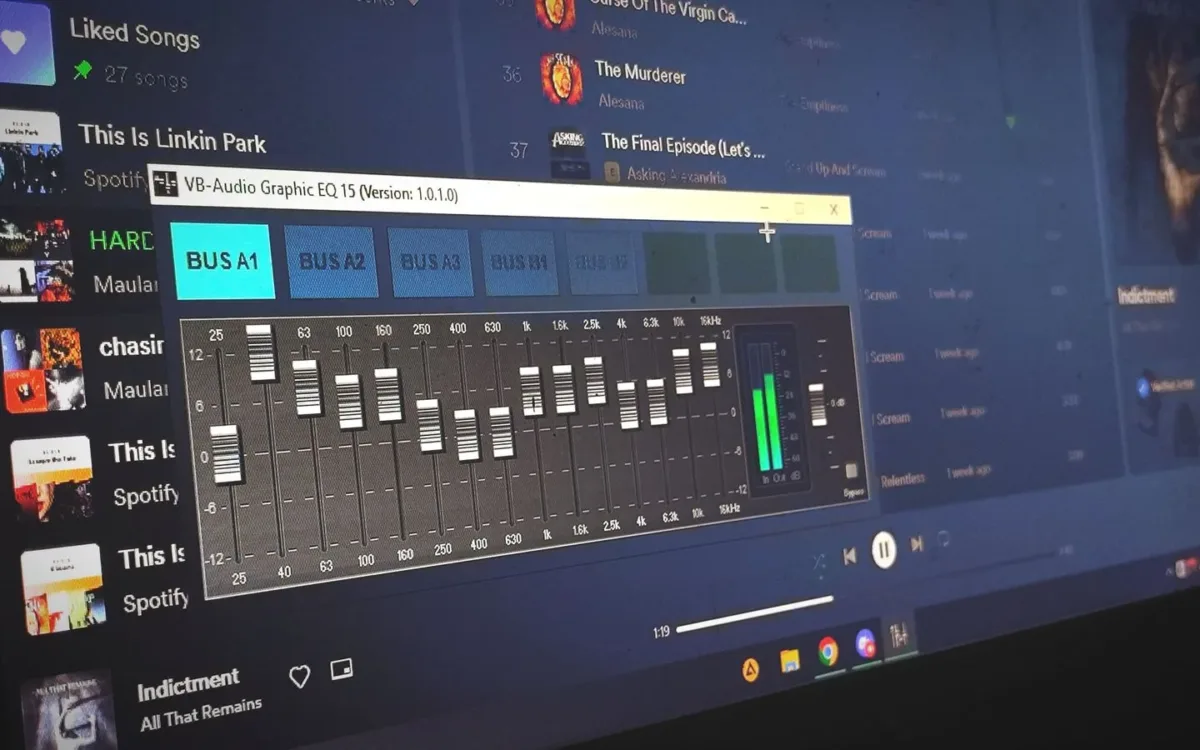
The best EQ settings use cuts, not boosts. Audio Intensity recommends 5 to 10 corrections per channel and no boost above 3 dB, with a Q of 4 to 8 for narrow resonances and 0.7 to 1.5 for broad corrections (Audio Intensity, 2026).
There is no single EQ curve that fits every car, because every cabin has different peaks. Common problem areas include:
- A bass peak between 80 and 150 Hz from cabin resonance and door panels.
- A harsh region between 2 and 4 kHz from windshield reflections.
- Uneven treble from tweeters aimed off-axis.
Measure these with a microphone before cutting. Leave deep, narrow dips alone, because they are usually cancellations that boost cannot fix.
Best Subwoofer Settings in a DSP
For the subwoofer, set a low-pass filter around 80 Hz, a subsonic high-pass filter to protect the driver, and a delay that makes the bass sound like it comes from the front. Then set the level last, and lower than you might expect.
Subsonic filter guidance:
- Sealed box: about 25 Hz (Audio Intensity, 2026).
- Ported box: slightly below the box tuning frequency, to stop the cone from over-travelling below the port’s working range.
Car cabins add bass on their own. Audio Intensity reports about 12 dB per octave of cabin gain below roughly 80 Hz (Audio Intensity, 2026). That is why a subwoofer that sounds right at home can sound boomy in a car. Cut the subwoofer level or add a broad EQ cut below 50 Hz if the low end is overpowering.
To check subwoofer polarity, play a track with steady bass near the crossover frequency and flip the subwoofer phase in the software. Keep the setting that gives more bass at the driver’s seat.
Best Settings for Rear Speakers
Use rear speakers as quiet fill, not as a second front stage. Set them several decibels lower than the fronts, high-pass them higher than the front woofers, and give them the least delay or none at all, so the stage stays in front of you.
Suggested starting point:
| Setting | Rear speakers |
|---|---|
| High-pass | 100 to 125 Hz |
| Level | 6 to 10 dB below the fronts |
| Delay | Zero or less than the fronts |
Many tuners turn rear speakers off in the driver preset and keep them on for a passenger preset. If the rear seat is often occupied, keep them on at a low level.
Best Input Settings for a Factory Radio
With a factory radio, set the inputs before any other setting. Sum split factory channels back into full-range left and right, then turn on de-EQ to remove the factory tuning curve (Audio Intensity, 2026). Use high-level inputs only, never high-level and low-level at the same time.
Set the factory radio’s own tone controls to their center positions and turn off any surround or sound mode. Some factory systems change their EQ with volume; the processor’s de-EQ or input EQ can flatten that too. Our guide on how to use DSP in car audio covers factory integration step by step.
Quick-Reference Starting Settings
Use this table as a one-page starting point, then refine with measurements and listening. If you are still choosing hardware, the best DSP for car audio is one with enough channels, 24 dB per octave filter options, fine delay steps and at least 10 parametric bands per channel so these settings are possible.
| Setting | Starting value |
|---|---|
| Crossover type | Linkwitz-Riley, 24 dB/oct |
| Subwoofer low-pass | 80 Hz |
| Subsonic (sealed) | 25 Hz |
| Front woofer high-pass | 80 Hz |
| Tweeter high-pass | About 3 kHz |
| Source volume for gain setting | 75% |
| DSP master | 0 dB |
| Amplifier gain | 2 to 3 dB below distortion |
| Time alignment | Distance difference ÷ 13.5 = ms |
| EQ | 5 to 10 cuts per channel, max 3 dB boost |
For background on why each tool works, read how a DSP works in a car.
Frequently Asked Questions About the Best DSP Settings
What is the best crossover frequency for car speakers?
For most systems, start with the subwoofer low-passed at 80 Hz, door woofers high-passed at 80 Hz and tweeters high-passed around 3 kHz, all at 24 dB per octave. Adjust for the size and location of your speakers.
What slope should I use on a DSP crossover?
Use 24 dB per octave Linkwitz-Riley as the default. It protects tweeters and sums flat at the crossover point. Try 12 or 18 dB per octave only between drivers mounted close together.
Should I boost bass in the DSP?
Usually not. Car cabins already add bass below about 80 Hz. Set the subwoofer level with the channel gain, use small EQ cuts where the bass is boomy, and keep any boost to 3 dB or less.
What are the best DSP settings for sound quality?
Accurate time alignment, clean gain structure, crossovers that suit each speaker and modest EQ cuts toward a target curve. Sound quality comes from getting each step right in order rather than from one special setting.
Can I copy someone else’s DSP settings?
You can use their crossover points as a starting point if you have the same speakers. Time alignment and EQ depend on the exact car, speaker locations and seat position, so they need to be measured in your car.
What subsonic filter setting should I use?
For a sealed box, around 25 Hz is a common starting point (Audio Intensity, 2026). For a ported box, set it slightly below the box tuning frequency to protect the subwoofer.
Summary: Best DSP Settings for Car Audio
- Crossovers: Linkwitz-Riley 24 dB/oct, subwoofer below 80 Hz, woofers from 80 Hz, tweeters from about 3 kHz.
- Gain: 75% source volume, DSP master at 0 dB, amplifiers 2 to 3 dB below distortion.
- Time alignment: inches of difference divided by 13.5 gives milliseconds of delay.
- EQ: cut peaks, limit boost to 3 dB, and refine everything with measurements and listening.