Quick Answer
- To get rid of engine noise in a car stereo, work out which kind of noise it is, find how it gets in, then fix that path: the stereo’s ground, its power lead, the antenna, or the engine’s charging and ignition parts.
- A whine that rises and falls with engine speed is alternator noise. A ticking that speeds up as you accelerate is ignition noise (Crutchfield, 2026).
- If the noise is only on AM and FM, it is most likely coming through the antenna lead (Crutchfield, 2026).
- Test the alternator with a multimeter set to AC volts. Fluke calls 50 millivolts or less desirable, and above 0.3 to 0.5 volts points to an internal fault (Fluke, 2026).
- Filters help, but Crutchfield notes that alternator noise most often comes from a loose or intermittent ground connection (Crutchfield, 2026).
To get rid of engine noise in a car stereo, identify the noise first, then run a few quick tests to see where it enters. Noise that follows engine speed reaches the stereo by one of four routes: the power wire, the ground, the antenna, or radiation into the unit and its cables. Most cases are cured by a better ground for the stereo. The rest need a filter on the right wire or a repair under the hood.
What Engine Noise Sounds Like
Engine noise is any sound from the speakers that changes with the engine. Crutchfield defines noise introduced through the power and ground wires connected to the receiver as engine noise or alternator whine (Crutchfield, 2026).
| What you hear | Source | How it behaves |
|---|---|---|
| High-pitched whine | Alternator | Pitch rises and falls with engine RPM |
| Ticking or popping | Ignition system | Speeds up as you accelerate |
| Buzz for a second or two at key-on | Fuel pump | Does not follow RPM |
| Clicks or whir with one switch | Wiper, blower or other motor | Only while that accessory runs |
The whine exists because of how an alternator makes power. BestCarAudio explains that its rectifier produces a DC voltage with a lot of ripple, and that the noise typically changes in frequency with the engine’s speed (BestCarAudio, 2024).
The fuel pump has its own test. Turn the key to ON without starting the engine. If the noise appears for a second or two and stops as the fuel system pressurizes, the pump is the source (ARRL, 2004).
This guide covers noise heard through the stereo itself, with or without an amplifier. If your system has an amplifier and the noise remains with the engine off, see our guide on how to remove humming noise from a car amplifier.
Step 1: Find Out How the Noise Gets In
Four short tests narrow the search before you buy anything.
- Rev the engine in neutral. Whine that tracks RPM is the alternator, and ticking is ignition.
- Change sources. Crutchfield’s test is to check CD, AUX or USB, AM and FM. If the noise is present only on the radio, it is most likely coming through the antenna lead (Crutchfield, 2026).
- Unplug the antenna. If the noise goes away, the antenna path is confirmed (Crutchfield, 2026).
- Pull the stereo out of the dash while it plays. If the noise goes away, it was being radiated into the unit by something nearby, such as a heater motor or a car computer (Crutchfield, 2026).
A fifth check helps with whine: switch the headlights on. Music in Motion notes that the whine gets stronger because the alternator must work harder to maintain voltage (Music in Motion, 2026).
| Test result | Where to look |
|---|---|
| Noise on every source | Stereo ground and power (Steps 2 and 3) |
| Noise only on AM and FM | Antenna (Step 4) |
| Noise stops with the stereo out of the dash | Radiated noise (Step 4) |
| Loud whine, worse with headlights on | Alternator (Step 5) |
| Ticking that follows RPM | Ignition (Step 6) |
Step 2: Fix the Stereo’s Ground
Start with the ground, because it is the most common cause and costs nothing to fix. Crutchfield states that an improper ground is one of the biggest causes of noise in an audio system (Crutchfield, 2026).
The stereo’s black wire should be bolted to clean, bare metal on the car’s body. Crutchfield suggests checking whether the ground wire sits near a noise source such as the heater, the air conditioning or a computer, and whether it is really connected to the vehicle’s ground (Crutchfield, 2026).
Manufacturers add two rules. Pioneer says to ground the black lead separately from the ground of high-current products such as power amplifiers (Pioneer, 2026). Rockford Fosgate says to re-ground components to clean, shiny metal that is free of paint and rust (Rockford Fosgate, 2013).
Remake the connection even if it looks sound: undo it, sand the metal bright and bolt it down with a star washer. Our guide on how to ground an amplifier in a car shows the same technique, and it applies to a head unit as well.
Step 3: Filter the Stereo’s Power Lead
If the ground is good and the whine remains on every source, the noise is riding in on the power wire. A power line noise filter goes in line on the stereo’s 12-volt lead.
Match the filter to the current the stereo draws. Metra’s Install Bay IBNF10 is a 10-amp filter for car audio products with noise induced by alternators and other ignition sources (Metra, 2026). Crutchfield names 15-amp and 25-amp filters for the receiver’s power lead (Crutchfield, 2026).
Step 4: Deal With Antenna and Radiated Noise
Noise that appears only on AM and FM comes in through the antenna. Crutchfield explains that the antenna lead can act as a ground, which makes it a frequent noise path, especially when the stereo’s own ground is poor (Crutchfield, 2026).
The fix is an antenna noise suppressor. It plugs in line between the receiver and the antenna and breaks the ground path between them (Crutchfield, 2026). Check that the antenna’s base is tight and free of corrosion first.
Radiated noise is the other possibility. If pulling the stereo out of the dash stopped the noise, Crutchfield’s fix is magnetic shielding foil, also called Mu-metal, on the back of the receiver or around the wire that is radiating (Crutchfield, 2026). Rerouting the offending wire away from the stereo works as well.
For a motor-driven accessory such as a wiper or blower, a source noise filter can be installed on that accessory’s power lead (Crutchfield, 2026).
Step 5: Test the Alternator
A failing alternator makes more noise than any filter can remove. The Fluke 88V manual states that a good alternator should measure less than 0.5 volts AC with the engine running, and that a higher reading indicates damaged alternator diodes (Fluke, 2026).
Fluke’s test procedure is short (Fluke, 2026):
- Let the engine idle for about 30 seconds with accessories switched on.
- Set the multimeter to AC volts, on the millivolt range if it has one.
- Put the red probe on the alternator’s output terminal or the battery’s positive post, and the black probe on the battery’s negative post.
- Read the meter, then raise the engine to 2,000 to 2,500 rpm and read it again.
| AC ripple reading | Meaning |
|---|---|
| 50 mV or less | Desirable |
| 50 to 100 mV | Monitor |
| Above 0.3 to 0.5 V | Internal fault: rectifier diode or stator |
Fluke’s guide on testing alternator ripple voltage shows the meter setup.
If the alternator fails the test, replace it. A healthy alternator that still whines can be fitted with an alternator noise suppressor, which connects in line between the alternator and the battery (Crutchfield, 2026).
Step 6: Fix Ignition Noise
Ticking that follows engine speed comes from the ignition system. The fix is under the hood, and it is the same work as a tune-up.
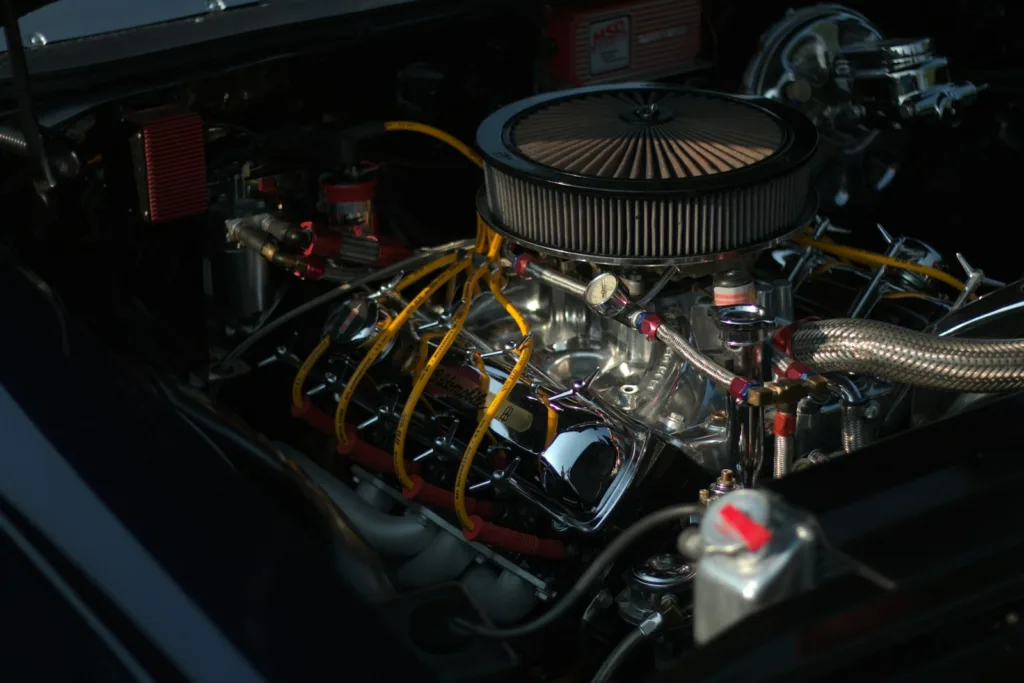
Crutchfield’s list is resistor-type spark plugs, shielded carbon-core spark plug wires, and on older engines the distributor cap and coil (Crutchfield, 2026). Each part limits radio interference at its source:
- Resistor spark plugs. Champion explains that resistor plugs reduce the radio frequency interference that can cause static on the radio, and that an R in the part number marks a resistor type (Champion, 2026).
- Plug wires. NGK notes that the resistance of solid carbon core wires tends to increase over time (NGK, 2026). The ARRL suggests looking for arcing in the dark, which is an obvious sign that the wires need replacement (ARRL, 2026).
- Ground straps. Crutchfield says that if grounding an under-hood part cures the noise, the fix should be made permanent with a braided ground strap (Crutchfield, 2026).
Step 7: Strengthen the Car’s Grounds
If several fixes each helped a little, the car’s main grounds may be weak. Rockford Fosgate recommends adding a second ground from the battery’s negative terminal to the chassis or engine block, and having the alternator and battery load tested (Rockford Fosgate, 2013).
That extra ground is part of what installers call the Big 3: heavier wire from alternator to battery positive, from battery negative to chassis, and from chassis to engine (Crutchfield, 2026). Crutchfield adds that if noise persists, a mechanic should check the alternator and battery (Crutchfield, 2026).
Which Noise Filter Do You Need?
Buy a filter only after the tests point to one path. Each filter treats a single route.
| Filter | Where it goes | Fixes |
|---|---|---|
| Power line filter | On the stereo’s 12 V lead | Whine on every source |
| Antenna noise suppressor | Between stereo and antenna | Noise on AM and FM only |
| Alternator noise suppressor | Between alternator and battery | Whine that tracks RPM |
| Ground loop isolator | On RCA or AUX cables | Noise entering through signal cables |
Ground loop isolators have a cost in sound quality. In a BestCarAudio bench test, a transformer isolator moved the low-frequency limit from 2.8 Hz to about 46 Hz (BestCarAudio, 2024), so use one only when rewiring has failed.
If the noise is a crackle on bumps or at high volume, not a sound that follows the engine, see our guide on fixing crackling car speakers.
Frequently Asked Questions About Engine Noise in a Car Stereo
Why does my car stereo whine when I accelerate?
Alternator ripple is reaching the audio path, usually through a poor ground. The pitch rises with engine speed because the alternator spins faster (BestCarAudio, 2024).
How do I know if the noise is coming through the antenna?
It is heard only on AM and FM, and it stops when you unplug the antenna from the back of the stereo (Crutchfield, 2026).
What is a normal alternator AC ripple reading?
Fluke calls 50 millivolts AC or less desirable at idle with accessories on. Its 88V manual gives 0.5 volts AC as the limit, above which the diodes are damaged (Fluke, 2026).
Will a noise filter fix alternator whine?
It can, if the noise is entering on the power lead. Crutchfield notes that alternator noise most often comes from a loose or intermittent ground (Crutchfield, 2026), so check the ground first.
Can spark plugs or plug wires cause radio noise?
Yes. Resistor spark plugs and suppression wires exist to limit radio interference (Champion, 2026), and worn wires can arc and radiate noise.
Summary: How to Get Rid of Engine Noise in Car Stereo
- Identify the noise: whine is the alternator, ticking is ignition, and a brief buzz at key-on is the fuel pump.
- Test by changing sources, unplugging the antenna and pulling the stereo from the dash.
- Remake the stereo’s ground on bare metal before you buy a filter.
- Measure alternator ripple, and replace worn ignition parts if the noise ticks with the engine.