Quick Answer
- To fix car speakers crackling, first note when it happens: only at high volume, only on one speaker, only on one source, or when the car hits a bump. Each pattern points to a different cause.
- Crackling that comes and goes with bumps or door movement is usually a loose or broken speaker wire, most often where the wires pass through the door hinge boot.
- Crackling only at high volume is usually clipping, which happens when the signal exceeds what the head unit or amplifier can deliver (Crutchfield, 2026). Lower the volume, bass boost and amplifier gain.
- A muffled, crackling sound on every song usually means a damaged voice coil (Sonic Electronix, 2026), and that speaker needs replacing.
- If the crackle follows the amplifier channel when you swap speaker wires, the amplifier, RCA cables or head unit is the cause, not the speaker.
To fix car speakers crackling, find the pattern first, then fix the matching cause: tighten or repair loose speaker wires, lower the volume and gain if it only crackles when loud, replace a bad AUX or RCA cable, and replace any speaker with a damaged voice coil. Most crackling comes from a loose connection or from clipping, and both can be fixed without buying new speakers.
What Causes Car Speakers to Crackle?
Car speakers crackle when the electrical signal reaching the speaker is interrupted or distorted, or when the speaker itself is damaged. The most common causes are loose or corroded wiring, clipping from a head unit or amplifier pushed too hard, a faulty cable between the source and the stereo, and a worn or burned voice coil.
| What you notice | Most likely cause |
|---|---|
| Crackle on bumps or when a door moves | Loose or broken speaker wire |
| Crackle only at high volume | Clipping from the head unit or amplifier |
| Crackle on one source only | Bad AUX cable, phone connection or weak radio signal |
| Muffled crackle on every song, one speaker | Damaged voice coil or torn cone |
| Crackle on several speakers at once | Amplifier, RCA cables or head unit |
| Crackle with a scraping sound | Voice coil rubbing in the magnet gap |
Step 1: Find Out When and Where the Crackling Happens
Start by isolating the crackle. Use the balance and fader controls to play one speaker at a time, and note whether the noise is on one speaker or several. Then check whether it happens at low volume, only when loud, or only on rough roads.
This takes a few minutes and tells you where to look. One speaker crackling at any volume points to that speaker or its wiring. Every speaker crackling only when loud points to clipping. Crackling that appears on one input and not another points to the source.
Step 2: Rule Out the Source and Settings
Play the same song from a different source before you remove any panels. If the crackle is there on Bluetooth but not on USB or the radio, the speakers are fine and the phone connection, file or app is the cause.
Check these in order:
- AUX cable: a worn 3.5 mm cable crackles when it moves. Wiggle the plug at both ends, then try a new cable.
- Bluetooth: forget the phone on the stereo and pair it again, and turn off any EQ or volume boost in the music app.
- Radio only: crackling between stations or in weak signal areas is reception, not a speaker fault. Check that the antenna cable is seated behind the stereo.
- Tone settings: heavy bass or treble boost makes a small amplifier distort sooner. Set them near flat while you test.
Our guide to the best bass and treble settings for speakers in car gives safe starting values once the crackle is gone.
Step 3: Check the Speaker Wires and Connections
A crackle that comes and goes with bumps, door slams or window movement is usually a loose connection. Door speaker wires pass through a rubber boot at the door hinge, where they bend every time the door opens and can break inside the insulation.
Play music at low volume and test each point by hand:
- Open and close the door slowly and listen for the crackle to change.
- Remove the grille or door panel and press on the speaker terminals and plug.
- Wiggle the wires at the back of the head unit and at the amplifier’s speaker terminals.
- Look for green or white corrosion on terminals, which is common in doors that let in water.
A crackle that follows your hand shows you the fault. Re-crimp or replace loose connectors, clean corroded terminals, and repair a broken wire in the hinge boot with a soldered or crimped splice sealed with heat-shrink tubing.
Step 4: Inspect and Test the Speaker
If one speaker crackles on every song at any volume, inspect it. Sonic Electronix notes that a muffled, crackling sound is usually the result of a damaged voice coil (Sonic Electronix, 2026). A torn cone or a surround that has come loose can make a similar noise.
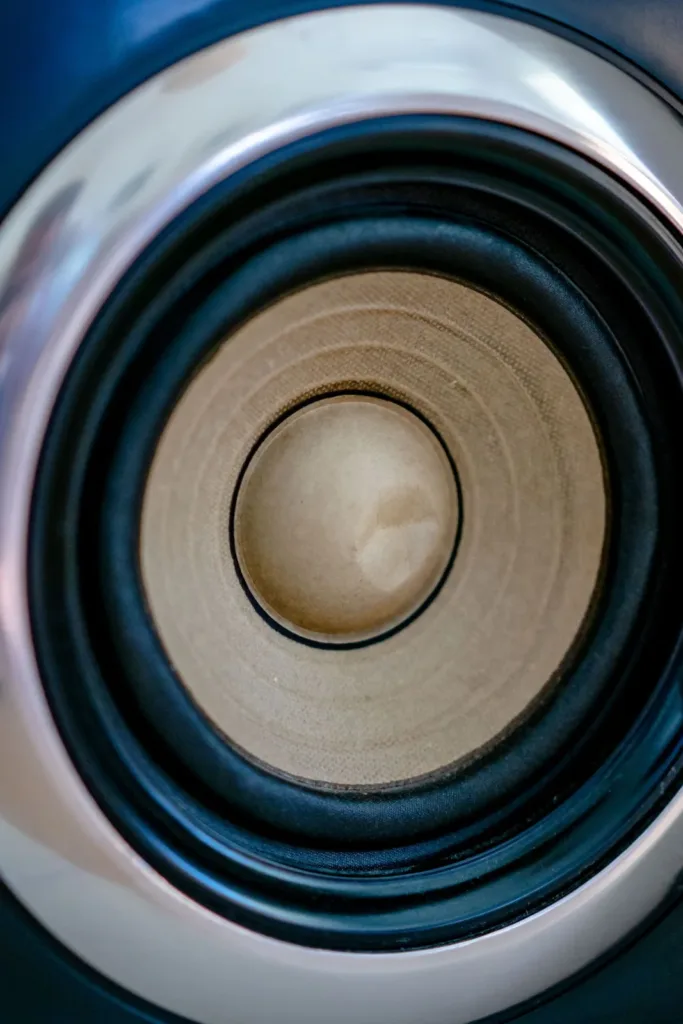
Press the cone in gently and evenly with your fingertips. It should move smoothly and silently. A scraping feel means the voice coil is rubbing, and that speaker needs replacing. Brush away any grit sitting on the cone or behind the grille too, since debris touching the cone can buzz and crackle; our guide on how to clean car speakers shows how to do it safely.
Then test the voice coil with a multimeter set to ohms, with the speaker unplugged. A healthy 4-ohm speaker reads a little below 4 ohms; the Kicker CSC65, for example, has a DC resistance of 3.3 ohms (Kicker, 2026). A reading that jumps around as you press the cone points to a failing lead wire, and an open reading means the coil has failed. Our guide on how to fix blown car speakers covers each test and which repairs are worth doing.
Step 5: Stop Clipping at High Volume
If the speakers only crackle when the volume is high, the cause is usually clipping. Crutchfield explains that clipping occurs when the volume of a source signal exceeds the electronic capability of a circuit (Crutchfield, 2026). The amplifier flattens the tops of the sound wave, and you hear it as crackle, buzz or harsh distortion.
Clipping also damages speakers. Crutchfield notes that a square wave carries twice the RMS power of a sine wave of the same amplitude, which overheats the voice coil (Crutchfield, 2026). Fix it at the settings:
- Turn the volume down to the point where the crackle stops, and treat that as the system’s clean limit.
- Turn off bass boost and loudness, and bring the bass and treble back toward flat.
- If you have an amplifier, lower its gain. Gain matches the amp to the head unit’s signal; it is not a volume control.
- Set a high-pass filter around 80 Hz for door speakers if your stereo or amp has one, so they stop trying to play deep bass.
Crutchfield’s method uses 0 dB sine wave test tones, and its rule is simple: when the hum turns into a buzz, it is clipping (Crutchfield, 2026). The full process is in Crutchfield’s guide on setting amplifier gain with test tones.
Step 6: Check the Amplifier and RCA Cables
If several speakers crackle, or the crackle stays after you fix the wiring, test the amplifier and its cables. Swap the left and right speaker wires at the amplifier. If the crackle moves to the other speaker, the fault is before the speaker: the amp channel, the RCA cables or the head unit.
Next, swap the left and right RCA plugs at the amplifier input. If the crackle moves again, the RCA cable or the head unit’s output is the cause. Crutchfield notes that inexpensive RCA cables often lack the shielding needed to keep noise out in a car (Crutchfield, 2026), and a loose RCA plug crackles when the car moves.
Check the amplifier’s ground as well. Crutchfield recommends a ground wire under 18 inches, bolted to bare metal (Crutchfield, 2026). If the crackle stays on one amp channel with good cables and a good ground, the amplifier itself may be failing; our guide on how to test a car amplifier with a multimeter walks through the checks.
Step 7: Replace a Speaker That Cannot Be Repaired
Replace a speaker when the voice coil is open, shorted or rubbing, or when the cone damage is too large to seal. Factory speakers are inexpensive to replace, and a new pair removes the crackle and usually improves the sound.
Measure the old speaker before you order so the new one fits the same opening and depth. Our guide on how to measure car speakers covers diameter, mounting depth and bolt pattern. Replace speakers in pairs, left and right, so both sides sound the same.
Frequently Asked Questions About Car Speakers Crackling
Why are my car speakers crackling?
The most common causes are a loose or broken speaker wire, clipping from too much volume or gain, a faulty AUX or RCA cable, and a damaged voice coil. Note when it happens, such as on bumps, at high volume or on one source, to narrow it down.
Why do my car speakers crackle at high volume?
Crackling only at high volume is usually clipping, which occurs when the signal exceeds what the head unit or amplifier can deliver (Crutchfield, 2026). Lower the volume, bass boost and amplifier gain. If it also crackles at low volume, check the speaker and wiring.
Does crackling mean my speaker is blown?
Not always. A blown speaker usually crackles or sounds muffled on every song at any volume. Crackling that changes with bumps, door movement or the source points to wiring or cables instead. A multimeter test on the speaker terminals confirms it.
Can a bad wire make a car speaker crackle?
Yes. A loose terminal, a corroded connector or a wire broken inside the door hinge boot interrupts the signal and causes crackling that comes and goes. Wiggle the wiring while music plays at low volume to find it.
Why does only one car speaker crackle?
One crackling speaker points to that speaker, its wiring or its amplifier channel. Swap the left and right speaker wires at the amplifier or head unit. If the crackle moves, the fault is in the electronics; if it stays, it is the speaker or its wire.
Can crackling damage my car speakers?
Crackling from clipping can. A clipped signal carries more power than clean music at the same level and overheats the voice coil (Crutchfield, 2026). Turn the volume down as soon as you hear it.
Summary: How to Fix Car Speakers Crackling
- Find the pattern first: one speaker or all, low volume or high, one source or every source.
- Fix loose, corroded or broken speaker wires, starting at the door hinge boot and the terminals.
- Stop clipping by lowering volume, bass boost and amplifier gain.
- Test the speaker with a multimeter and replace it if the voice coil is damaged.