Quick Answer
- To upgrade car speakers, find the sizes your car uses, decide between coaxial and component speakers, then match sensitivity and RMS power to your stereo or amplifier.
- On a factory stereo, choose speakers with sensitivity over 90 dB; most factory head units put out only 10 to 18 watts RMS (Crutchfield, 2026).
- RMS power handling is the spec that matters, not peak power (Crutchfield, 2026). For head-unit power, a 20 to 50 watt RMS rating is a safe match.
- Component speakers put the tweeter higher for better imaging, while coaxial speakers drop into the factory location with less work (Crutchfield, 2026).
- Cars with premium factory systems often use 2-ohm speakers, and standard 4-ohm replacements can play noticeably quieter (Crutchfield, 2026).
To upgrade car speakers, start with fit, then choose by how they will be powered. Measure or look up the factory sizes, pick coaxial speakers for a simple swap or component speakers for better imaging, and buy high-sensitivity models if you are keeping the factory stereo. Replace the front speakers first, because they shape most of what the driver hears.
Why Upgrading Car Speakers Makes a Difference
Factory speakers are built to a low cost. BestCarAudio describes typical factory speakers as using paper cones, foam surrounds and small magnets (BestCarAudio, 2026). Aftermarket speakers use stiff, lightweight cone materials and better surrounds, which is why Crutchfield calls speakers the single most cost-effective improvement to a car’s sound (Crutchfield, 2026).
You will hear clearer vocals, cleaner treble and tighter midbass. You will not get deep bass from door speakers alone, and new speakers cannot fix a weak or distorted source. Those limits decide what you buy next.
Step 1: Find Out What Fits Your Car
Start with size, because the best speaker is useless if it does not fit. The most common sizes are 6-1/2″ and 6×9″, with round sizes from 3-1/2″ to 8″ and several ovals also in use (BestCarAudio, 2021).
Diameter is only part of fit. Crutchfield notes that mounting height and depth, along with tweeter protrusion, are major factors in whether a speaker fits (Crutchfield, 2026). A speaker that is too deep can hit the window glass, and a tweeter that sticks out too far can touch the grille.
Sizes are also less exact than they sound. Crutchfield points out that a 6-1/2″ speaker is not actually 6-1/2″ in diameter, and that 6-1/2″ and 6-3/4″ speakers have different hole patterns (Crutchfield, 2026). Our guide on how to measure car speakers shows how to check diameter, cutout, depth and bolt pattern on the speaker you already have.
Step 2: Choose Coaxial or Component Speakers
Coaxial speakers, also called full-range speakers, contain all the speaker elements in one basket: a woofer for the lows and a tweeter for the highs (Crutchfield, 2026). Component speakers use separate woofers, tweeters and external crossovers.
| Coaxial (full-range) | Component | |
|---|---|---|
| Design | Woofer and tweeter in one unit | Separate woofer, tweeter and crossover |
| Sound | Clear upgrade over factory | Better imaging and detail |
| Installation | Drops into the factory location | Tweeters and crossovers need mounting |
| Best for | Simple swaps and rear speakers | Front doors and sound-quality builds |
Crutchfield says component speakers give better imaging and a much more detailed and dynamic sound than conventional speakers (Crutchfield, 2026). The reason is tweeter position: mounted high on the door or dash, the tweeter aims treble at your ears instead of your knees.
Choose coaxials if you want a quick swap, and components if your car already has separate factory tweeters or you plan to add an amplifier.
Step 3: Match Sensitivity to Your Power Source
Sensitivity tells you how loud a speaker plays for a given amount of power. For low-powered factory stereos, Crutchfield says speakers with high sensitivity ratings, over 90 dB, make the best match, while high-power systems suit speakers with lower sensitivity ratings (Crutchfield, 2026).
| Power source | Typical power | What to look for |
|---|---|---|
| Factory stereo | 10 to 18 W RMS | Sensitivity over 90 dB, low RMS range |
| Aftermarket stereo | About 14 to 22 W RMS | Sensitivity around 90 dB or higher |
| External amplifier | 50 W RMS or more | RMS rating that matches the amp |
The full spec-by-spec breakdown is in Crutchfield’s car speakers buying guide.
Sensitivity is not a quality score. Crutchfield notes that efficiency ratings do not tell you how good a speaker sounds; they only indicate how well it uses power (Crutchfield, 2026). If volume is the main goal, our guide on making car speakers louder without an amp covers the other free gains.
Step 4: Check RMS Power Handling
Match the speaker’s RMS rating to the power it will actually receive. Crutchfield states that the spec to watch is the maximum RMS power handling, not peak power, because RMS realistically measures what the speaker can handle continuously (Crutchfield, 2026).
Most factory head units put out 10 to 18 watts RMS, and Crutchfield calls a 20 to 50 watt RMS rating a safe bet for them as long as sensitivity is around 90 dB or higher (Crutchfield, 2026). A speaker with a lower RMS range suits a stereo, and a higher RMS range works better with an external amplifier (Crutchfield, 2026).
Ignore large peak numbers on the box. A speaker rated at 300 watts peak and 50 watts RMS is a 50-watt speaker.
Step 5: Check Impedance on Premium Factory Systems
Most aftermarket car speakers are 4 ohms, and that suits most cars. Premium factory systems are the exception. Crutchfield warns that some cars use low-impedance speakers, and that replacing 2-ohm speakers with standard 4-ohm aftermarket speakers causes a significant loss of volume (Crutchfield, 2026).
If your car has a branded factory system with its own amplifier, look for 2-ohm or 3-ohm replacement speakers. Crutchfield notes that Infinity Reference speakers work with 3-ohm systems as well as traditional 4-ohm systems (Crutchfield, 2026). The impedance is usually printed on the factory speaker’s magnet.
Step 6: Compare Cone, Surround and Tweeter Materials
Materials affect both sound and lifespan. Crutchfield says rubber surrounds provide the best overall performance and longevity, while foam and cloth surrounds cost less and still perform well (Crutchfield, 2026).
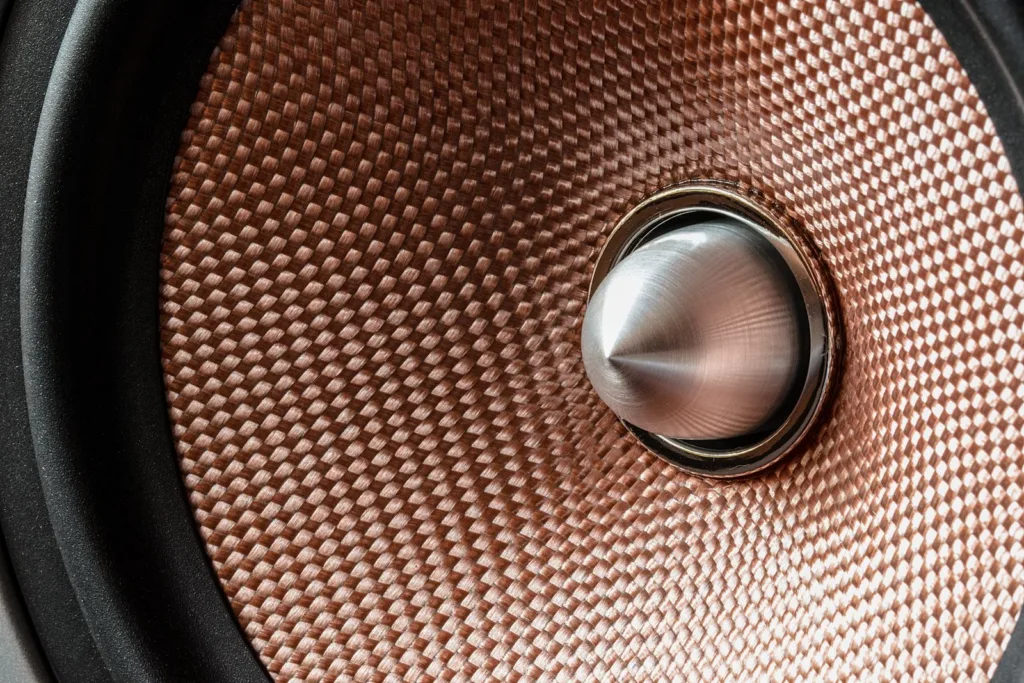
Tweeters follow a simple rule. Soft materials such as poly, textile blends or silk sound refined and smooth, and hard materials such as metal or graphite give bright, snappy highs (Crutchfield, 2026). If your car’s tweeters sit close to your ears, soft domes are easier to live with on long drives.
For doors that see rain or trail dust, consider marine-certified speakers. Polk, for example, tests its marine-certified car speakers for salt-fog, UV and humidity (Polk Audio, 2026).
Step 7: Decide Whether You Need an Amplifier
You do not need an amplifier to upgrade speakers. Crutchfield says aftermarket speakers certainly sound better with more power, but most will sound fine with factory power (Crutchfield, 2026).
Add an amplifier when you want more volume without distortion, or when you choose speakers with RMS ratings above about 50 watts. Our guide on how to choose an amplifier for car speakers explains channels and power matching.
A subwoofer is the other upgrade to consider. BestCarAudio explains that when a sub handles bass below 80 Hz, the door speakers do not need to work as hard and play with less distortion (BestCarAudio, 2021). If bass is what you are missing, choosing a subwoofer for your car may do more than a second pair of speakers.
Step 8: Plan the Order and the Budget
Upgrade the front speakers first. They sit closest to the driver, and their tweeter position does most for clarity (BestCarAudio, 2021). Rear speakers add fill for passengers, so they can wait or stay factory.
| Budget level | What to buy |
|---|---|
| Lowest cost | Front coaxial pair, high sensitivity |
| Balanced | Front component set, rear coaxial pair |
| Sound quality | Front components, amplifier and sound deadening |
Prices cover a wide range. Crutchfield’s budget picks for 2026 run from $79.99 to $199.95 a pair (Crutchfield, 2026), and BestCarAudio notes that 6-1/2″ sets start at about $55 and reach well over $5,500 (BestCarAudio, 2021).
Budget a little for the door itself. BestCarAudio measured improvements of 10 dB in bass frequencies after sealing and deadening a door, with no other changes to the system (BestCarAudio, 2020). Foam rings and a sheet of deadening behind each speaker are low-cost additions.
When the parts arrive, our step-by-step guide on how to install new speakers in car doors covers panels, wiring and polarity. For the bigger picture, see our plan for upgrading a car audio system in stages.
Frequently Asked Questions About Upgrading Car Speakers
Will my factory radio power aftermarket speakers?
In most cases, yes. Crutchfield says most of its speakers will sound fine with factory power (Crutchfield, 2026). Choose a sensitivity over 90 dB and a modest RMS rating so the factory stereo’s 10 to 18 watts goes further.
Do I need an amplifier for new car speakers?
No, but it helps. Speakers with high sensitivity work well on a stereo alone. An amplifier adds clean volume and is worth it for speakers rated above about 50 watts RMS.
Are component speakers better than coaxial?
For sound quality, yes. Separate tweeters mounted higher give better imaging and detail (Crutchfield, 2026). Coaxial speakers are easier to fit and cost less, which makes them a good choice for rear doors and simple swaps.
Should I upgrade front or rear speakers first?
Front speakers first. They are closest to the driver and carry most of what you hear. Rear speakers mainly add fill for passengers.
Can I replace 2-ohm factory speakers with 4-ohm speakers?
You can, but they will play quieter. Crutchfield warns of a significant loss of volume when 4-ohm speakers replace 2-ohm factory speakers (Crutchfield, 2026). Look for 2-ohm or 3-ohm replacements instead.
What size speakers fit my car?
It depends on the vehicle and the location. The most common sizes are 6-1/2″ and 6×9″ (BestCarAudio, 2021). Check a fit guide for your year and model, or measure the factory speaker’s diameter, depth and bolt pattern.
Summary: How to Upgrade Car Speakers
- Confirm size, mounting depth and tweeter height before you buy.
- Choose coaxial speakers for a simple swap and component speakers for better imaging.
- Match sensitivity and RMS power to your stereo or amplifier, and ignore peak ratings.
- Check impedance on premium factory systems, and upgrade the front speakers first.