Quick Answer
- The best bass and treble settings for speakers in a car start from flat, then bass at about +3 dB, midrange at 0 and treble at +1 to +2 dB on a three-band control (Audio Intensity, 2026).
- Keep bass boosts small because the car cabin already adds bass: cabin gain adds about 12 dB per octave below roughly 70 to 90 Hz (Audio Intensity, 2026).
- Every 3 dB of extra level needs twice the amplifier power, so large bass boosts make a factory stereo distort sooner (Crutchfield, 2026).
- Use only one equalizer at a time and keep any others flat, and play a good-quality source while you adjust (Crutchfield, 2026).
- Factory speakers usually sound best with modest bass and treble, while bright aftermarket tweeters often need treble at 0 or one step below.
The best bass and treble settings for speakers in car audio systems are small changes from flat: bass up about 3 dB, midrange at 0 and treble up 1 to 2 dB. That starting point adds weight and clarity without making the speakers boom, distort or sound harsh. From there, a few adjustments for your speakers, your music and road noise get you the rest of the way.
What Bass, Mid and Treble Controls Change
The bass control changes the lowest notes, the midrange control changes voices and most instruments, and the treble control changes the highest notes. Crutchfield describes bass as the lower frequencies below 100 Hz, and treble as the highest frequencies in the music (Crutchfield, 2026).
In practice, bass covers kick drums, bass guitar and synth bass. Midrange covers vocals, guitars and piano, and it decides whether music sounds clear or muddy. Treble covers cymbals, the “s” sounds in vocals and the sense of detail and space.
Most car stereos show these controls as numbered steps, such as -6 to +6 or -12 to +12, rather than decibels (dB). Check your manual to see how much each step changes the sound; on many units, one step is 1 or 2 dB.
Why Cars Need Less Bass Boost Than You Expect
A car cabin boosts bass on its own. Audio Intensity measures this cabin gain at about 12 dB per octave below roughly 70 to 90 Hz (Audio Intensity, 2026). Because the space is small and closed, low notes build up, so a bass setting that sounds right at home often sounds boomy in a car.
Your ears pull the other way at low volume. The ISO 226:2023 equal-loudness data cited by Audio Intensity shows the ear needs 77.78 dB of sound at 50 Hz to hear it as loud as 40.01 dB at 1 kHz (Audio Intensity, 2026). That is why music sounds thin at low volume and why a small bass boost helps.
Best Bass and Treble Settings for Most Cars
For most cars and most music, set bass to about +3 dB, midrange to 0 and treble to +1 to +2 dB. Audio Intensity uses these values as its three-band starting point (Audio Intensity, 2026).
| Control | Starting setting | What it does |
|---|---|---|
| Bass | About +3 dB | Adds weight without boom |
| Midrange | 0 (flat) | Keeps vocals natural |
| Treble | +1 to +2 dB | Adds clarity and detail |
| Balance and fader | Centered | Keeps the sound in front of you |
| Loudness and bass boost | Off while you set up | Stops extra, hidden boost |
If your stereo has a 5-band or larger graphic equalizer, Audio Intensity’s universal starting curve is +3 dB at 60 Hz, +1 dB at 250 Hz, 0 dB at 1 kHz, +2 dB at 4 kHz and +1 dB at 8 kHz (Audio Intensity, 2026). The same idea applies: a little low bass, a flat middle and a gentle lift in the upper range.
Best Bass and Treble Settings by Speaker Type
Your speakers change the best settings more than any other factor. Small, factory speakers cannot play deep bass cleanly, while aftermarket speakers with separate tweeters are often brighter than factory ones.
| Speaker setup | Bass | Treble |
|---|---|---|
| Factory speakers, no amplifier | 0 to +2 dB | 0 to +2 dB |
| Aftermarket coaxial speakers | +2 to +3 dB | 0 to +1 dB |
| Aftermarket component speakers | +2 to +3 dB | -1 to 0 dB |
| Any speakers with a subwoofer | 0 to +2 dB | +1 to +2 dB |
With factory speakers, a big bass boost mostly adds distortion, because each 3 dB increase needs double the amplifier power (Crutchfield, 2026) and a factory stereo has little to spare. If your stereo has a high-pass filter, set it around 80 Hz so the door speakers skip the deepest notes; our guide to the best crossover settings for car audio explains why.
With a subwoofer, leave the head unit’s bass close to flat and set the bass with the subwoofer level control instead. This keeps the door speakers clean and lets the subwoofer do the heavy lifting. For more low-end output, see our guide on getting deep bass from a car subwoofer.
Best Bass and Treble Settings by Music Genre
Different music styles need slightly different settings, mainly in the amount of bass. Audio Intensity’s genre curves give these values for the 60 Hz bass band and the 8 kHz treble band (Audio Intensity, 2026):
| Genre | Bass (60 Hz) | Treble (8 kHz) |
|---|---|---|
| Hip-hop and R&B | +6 dB | +1 dB |
| Pop | +4 dB | +2 dB |
| Rock | +3 dB | +3 dB |
| Jazz | +2 dB | +2 dB |
| Classical | +2 dB | +3 dB |
Treat the bass figures as a ceiling for factory speakers. A +6 dB bass setting for hip-hop needs four times the amplifier power at those notes, which works with an amplified system but will make most factory stereos distort. If you listen to several genres, pick the rock or pop values as a middle ground and adjust volume rather than EQ between songs.
How to Set Bass and Treble Step by Step
Set bass and treble while parked, with a good-quality source and every other sound effect off. This order stops one setting from hiding a problem in another.
- Park safely and play a song you know well from a high-quality source. Crutchfield recommends CD-quality or better files and warns that AM/FM radio and Bluetooth are compressed, so they are poorer for tuning (Crutchfield, 2026).
- Set bass, mid and treble to 0, and turn off loudness, bass boost and any “surround” or “stage” effects.
- Use only one equalizer. If your phone app, head unit and amplifier all have EQ, set all but one flat; Crutchfield warns that equalizing an already-equalized signal can cause distortion (Crutchfield, 2026).
- Center the balance and fader, then set the volume to your normal driving level.
- Raise bass one step at a time until the kick drum sounds full. Stop, and go back one step, when it starts to boom or blur.
- Raise treble one step at a time until cymbals and vocals sound clear. Go back one step if “s” sounds become sharp or tiring.
- Adjust midrange only if vocals sound buried (raise it) or nasal and boxy (lower it).
- Play two or three other songs, then check the settings at both low and high volume.
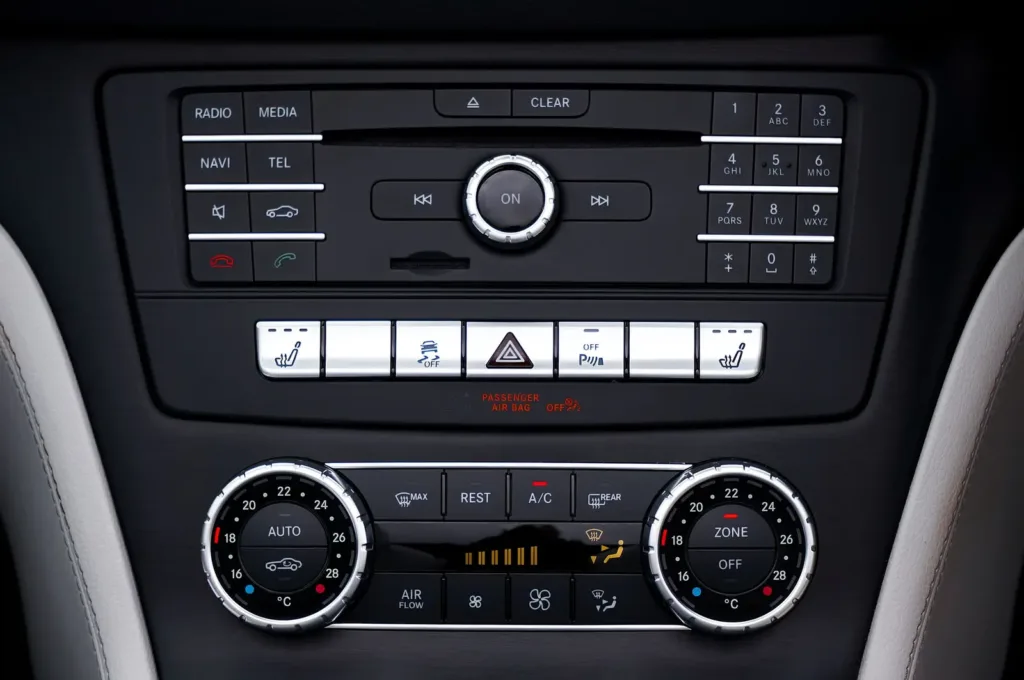
For a wider tune-up, including source quality and speaker placement, see our guide on getting the most out of your stereo.
Loudness, Bass Boost and Sound Effects
Loudness, bass boost and sound effects add hidden EQ on top of your bass and treble settings, so switch them off while you set up. Add them back only if they help.
Loudness raises bass, and often treble, at low volume to match how the ear hears quiet sound, as shown in the ISO 226:2023 curves (Audio Intensity, 2026). It helps at low volume but makes music boomy and distorted at high volume. Bass boost does the same at all volumes, so on a factory system it is often the first setting to turn off when the sound distorts. Our guide on how to make car speakers louder without an amp covers how these settings affect clean volume.
How Road Noise Changes the Best Settings
Road noise hides low bass and fine detail, so settings that sound right when parked can sound thin on the highway. Audio Intensity puts road noise inside a moving vehicle at about 66 to 70 dBA (Audio Intensity, 2026).
If the car has speed-sensitive volume, use it instead of raising the bass. Otherwise, raise bass one step for highway driving and set it back for town. Sound deadening in the doors cuts the noise itself and lets you run flatter settings.
Signs Your Bass and Treble Settings Are Wrong
Most bad car sound comes from too much bass or too much treble. Use this table to match what you hear with the fix.
| What you hear | Likely cause | Fix |
|---|---|---|
| Boomy, muddy bass | Bass too high for the cabin | Lower bass one or two steps |
| Distortion at high volume | Bass or loudness boost clipping the stereo | Lower bass, turn off loudness |
| Harsh, tiring sound | Treble too high | Lower treble one or two steps |
| Dull, flat vocals | Treble or midrange too low | Raise treble one step |
| Thin sound, little bass | Speaker out of phase or bass too low | Check speaker wiring, raise bass one step |
| Bass sounds like it comes from the trunk | Subwoofer low-pass set too high | Set the subwoofer low-pass near 80 Hz |
If you have an amplifier, check its bass boost and gain before changing the head unit again; our guide on how to tune your car amplifier covers the order. With a digital signal processor, use its parametric EQ instead of the tone controls; the best DSP settings for car audio guide lists starting values. The Crutchfield guide to adjusting a car equalizer and Audio Intensity’s car EQ settings guide give more examples.
Frequently Asked Questions About Car Bass and Treble Settings
What is the best bass and treble setting for car speakers?
Start with bass at about +3 dB, midrange at 0 and treble at +1 to +2 dB, with loudness and bass boost off (Audio Intensity, 2026). Then adjust one step at a time for your speakers and music.
Should bass be higher than treble in a car?
Usually, yes, but only slightly. The cabin already boosts bass, so a small bass lift of 2 or 3 dB and a smaller treble lift sound balanced in most cars.
What should my treble be set at in a car?
Set treble between 0 and +2 dB for most speakers. Lower it to 0 or one step below with bright aftermarket tweeters, and raise it one step if vocals sound dull.
Why do my car speakers distort when I turn up the bass?
Each 3 dB of extra bass needs twice the amplifier power (Crutchfield, 2026). A factory stereo runs out of clean power quickly, so large bass boosts clip the signal and the speakers distort.
Should I use the loudness setting in my car?
Use loudness at low volume, where it restores bass and treble your ears miss. Turn it off at normal and high volume, because it adds extra boost that can make the sound boomy and distorted.
What are good bass and treble settings for factory car speakers?
Keep both between 0 and +2 dB, turn off bass boost, and use a high-pass filter around 80 Hz if your stereo has one. Factory speakers play louder and cleaner with small settings than with big boosts.
Summary: Best Bass and Treble Settings for Speakers in Car
- Start flat, then set bass to about +3 dB, midrange to 0 and treble to +1 to +2 dB.
- Use smaller boosts with factory speakers and less treble with bright aftermarket tweeters.
- Turn off loudness, bass boost and sound effects while you set up, and use only one equalizer.
- Adjust one step at a time with a good source, then recheck at low and high volume.