Quick Answer
- To use a crossover in car audio, give each speaker the right filter: a high-pass for tweeters and door speakers, a low-pass for the subwoofer and a band-pass for any midrange speaker, then pick a frequency and slope for each.
- When adding a subwoofer, Crutchfield suggests starting both the front high-pass and the subwoofer low-pass at 100 Hz, then adjusting by ear (Crutchfield, 2025).
- Use one crossover per speaker band. Filters stacked on the head unit, the amplifier and a passive crossover shift the crossover point and thin out the sound.
- A crossover decides which speaker plays which notes. Use an equalizer, not the crossover, to shape the tone (Crutchfield, 2025).
- After the frequencies are set, balance the output levels so highs, mids and bass play at the same volume (Crutchfield, 2026).
Learning how to use a crossover car audio systems depend on comes down to three settings on each channel: the filter type, the crossover frequency and the slope. Set those correctly and each speaker plays only the notes it handles well. This guide explains where the controls are, what each one does and how to use them for the most common systems.
Where Crossover Controls Are in a Car Audio System
Crossover controls can be in four places: the head unit menu, the amplifier, a passive crossover box or a digital signal processor (DSP). Most systems have more than one, so the first job is choosing which one controls each speaker.
| Location | Controls you get | Best used for |
|---|---|---|
| Head unit menu | High-pass and low-pass, often with slope choices | Simple systems with an amplified subwoofer |
| Amplifier | HP, LP or Full switch, frequency knob, sometimes subsonic | Most amplified systems |
| Passive crossover box | Fixed points and a tweeter level switch | Component speaker sets |
| Active crossover or DSP | Every filter, slope and level per channel | 3-way and fully active systems |
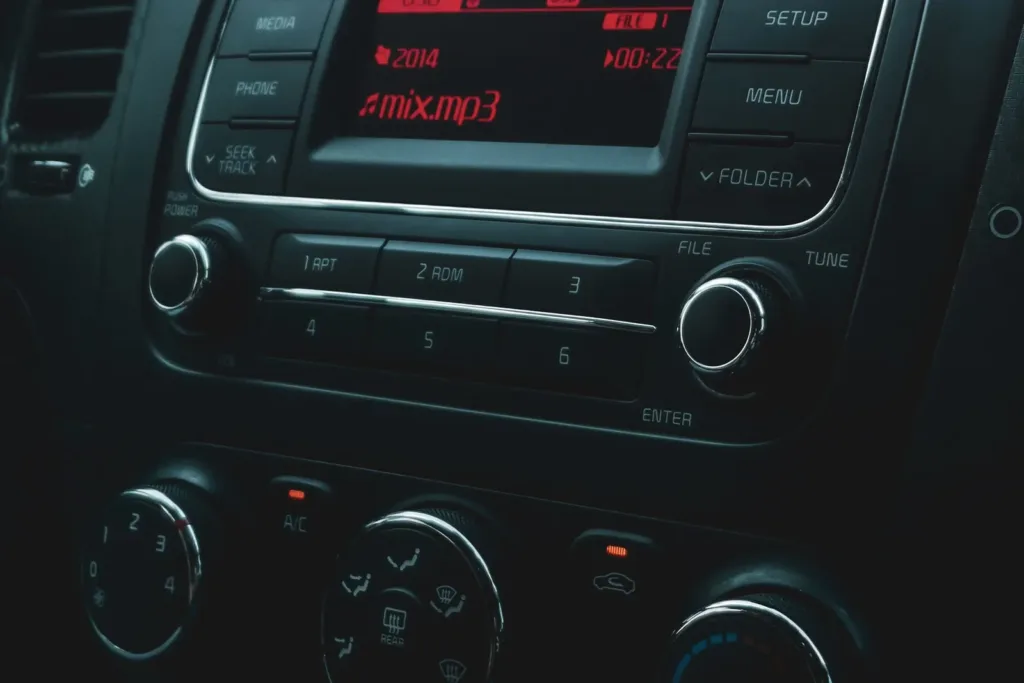
Pick one location for each speaker band and switch off the matching filter elsewhere. For example, if the amplifier’s low-pass filters the subwoofer, set the head unit’s subwoofer low-pass to off or its highest setting.
How to Read the Crossover Controls
Every crossover, whether it is a knob on an amplifier or a menu in a DSP, uses the same handful of controls. Once you know what each one does, the settings make sense on any brand.
- Filter mode (HP, LP, BP, Full). HP is high-pass, which blocks bass. LP is low-pass, which blocks everything above bass. BP is band-pass, which keeps a middle range. Full passes everything with no filter.
- Frequency. The crossover point in hertz (Hz). A high-pass at 80 Hz removes the notes below 80 Hz.
- Slope. How fast notes fade past the crossover point, in dB per octave. 24 dB per octave cuts faster than 12 dB per octave.
- Subsonic filter. A very low high-pass on the subwoofer channel that removes the deepest notes, used mostly with ported boxes (Crutchfield, 2025).
- Level or gain. Sets how loud each speaker group plays after filtering.
- Phase (0 or 180 degrees). Flips the subwoofer’s timing to help it blend with the front speakers.
For a full explanation of filters and slopes, read how a crossover works for car audio.
How to Use a Crossover With Front Speakers and a Subwoofer
The most common use is splitting the sound between front door speakers and one subwoofer. Set a high-pass on the front speakers and a low-pass on the subwoofer at the same frequency, then fine-tune by ear. Crutchfield uses this four-step method (Crutchfield, 2025):
- Set the front high-pass and the subwoofer low-pass to 100 Hz as a first guess.
- Turn the subwoofer off and play a song you know well. Adjust the front high-pass until no deep bass distorts through the door speakers and tweeters.
- Turn the front speakers down and the subwoofer back on. Lower the low-pass until vocals, guitars and cymbals disappear and only bass guitar, kick drum and synth bass remain.
- Turn everything on and make small changes to smooth out any bump or dip around the crossover point.
Many systems end up at 80 Hz on both filters with a 24 dB per octave slope. If the bass seems to come from the trunk, the subwoofer low-pass is probably too high; above roughly 80 Hz, the ear can tell where bass comes from (Audio Intensity, 2026). If the bass sounds weak at the driver’s seat, try the phase switch at 180 degrees.
How to Use an Amplifier’s Built-In Crossover
To use an amplifier’s built-in crossover, set the filter switch for each channel pair, then turn the frequency knob to your starting point. On a 4-channel amplifier powering door speakers, choose HP and set it to 80 Hz. On a mono subwoofer amplifier, choose LP and set it to 80 Hz.
Amplifier knobs are marked only roughly, so a knob pointing at 80 Hz may filter a little above or below. Check the frequency markings in the manual and trust your ears in the final pass. If your head unit also has crossover filters on the same outputs, turn those off or set the amplifier to Full, so only one filter works on each speaker. Our guide to tuning a car amplifier shows the order to set crossovers, gain and bass controls.
How to Use the Passive Crossover From a Component Set
A passive crossover from a component speaker set has fixed crossover points, so using it means wiring it correctly and choosing a tweeter level. The crossover already splits the tweeter and woofer, so you only add a high-pass on the amplifier or head unit channel that feeds it.
- Set the front channel high-pass to 80 Hz, and leave the low-pass off on those channels.
- Start the tweeter level switch at 0 dB. Move it to -3 dB if the highs sound bright, or -6 dB on crossovers that offer it (Crutchfield, 2025).
- Keep the passive crossover in the circuit unless you switch to an active crossover or DSP for the tweeter and woofer split.
If you have not wired it in yet, our guide on how to install a crossover in car audio covers mounting spots and wiring order.
How to Use an Active Crossover or DSP for a 3-Way System
In a 3-way system, each speaker gets its own amplifier channel and its own filter. Use the crossover or DSP to give the tweeter a high-pass, the midrange a band-pass, the midbass a band-pass and the subwoofer a low-pass, with matching frequencies at each handoff.
- Set the tweeter high-pass first, before any music plays. Start around 3,500 Hz for a 1-inch dome tweeter (Audio Intensity, 2026).
- Set the midrange band-pass, for example 250 Hz to 3,500 Hz for a 3-inch midrange.
- Set the midbass band-pass, for example 80 Hz to 250 Hz for a 6.5-inch door speaker.
- Set the subwoofer low-pass at 80 Hz, plus a subsonic filter if the box is ported.
- Use the same slope on both sides of each handoff, usually 24 dB per octave.
After the filters, balance the output levels. Crutchfield’s install guide says the first goal is to get each band of frequencies playing at the same volume, and only then apply EQ (Crutchfield, 2026). For the next steps after the crossover, see our guide to the best DSP settings for car audio.
Crossover Mistakes to Avoid
The most common crossover mistakes come from treating the crossover like a bass or treble knob. Each one below makes the system sound worse, even with good speakers.
- Using the crossover as a tone control. Crutchfield notes that crossover filters control how much signal goes to each speaker and should not be used as tone controls; that is the equalizer’s job (Crutchfield, 2025).
- Filtering twice. A head unit high-pass at 80 Hz plus an amplifier high-pass at 80 Hz doubles the slope and pulls the sound down around 80 Hz.
- Leaving the subwoofer on Full. Without a low-pass filter, the subwoofer plays vocals and the bass loses focus.
- Setting the subwoofer low-pass high for more bass. A 120 Hz low-pass adds boom and pulls the bass to the back of the car.
For exact starting values by speaker size, see our guide to the best crossover settings for car audio. The Crutchfield car audio crossovers FAQ is also a useful reference.
Frequently Asked Questions About Using a Crossover
How do I use a crossover with a subwoofer?
Set a low-pass filter on the subwoofer and a high-pass filter on the front speakers at the same frequency, usually between 80 and 100 Hz. Then listen to each group alone and adjust until the subwoofer plays no vocals and the door speakers play no deep bass.
Should I use the crossover on my head unit or my amplifier?
Use whichever gives you better control, but use only one on each speaker. Head units often offer more slope choices, while amplifier knobs are quicker to reach. Turn the unused one off or to Full.
What does the Full setting on an amplifier crossover mean?
Full means no filter, so the amplifier passes the whole frequency range to the speakers. Use it only when another crossover, such as the head unit or a DSP, already filters that channel.
Do I need to use a crossover for door speakers?
Yes, if you have a subwoofer. A high-pass around 80 Hz keeps deep bass away from the door speakers, which reduces distortion and door rattles and lets them play louder.
What is the phase switch for on a subwoofer crossover?
The phase switch flips the subwoofer’s timing by 180 degrees. If bass sounds weak or hollow at the driver’s seat, try the other setting and keep the one that sounds fuller.
Can a crossover fix harsh tweeters?
Often, yes. Raising the tweeter high-pass by 500 Hz or setting the passive crossover’s tweeter level to -3 dB usually softens harsh highs. If that does not help, use the equalizer to reduce the harsh frequency.
Summary: How to Use a Crossover in Car Audio
- Choose one crossover location for each speaker band and switch off duplicate filters.
- Use a high-pass on tweeters and door speakers, a low-pass on the subwoofer and a band-pass on any midrange.
- Start the front-to-subwoofer handoff at 80 to 100 Hz and fine-tune by ear.
- Balance levels after the filters, then use EQ for tone.