TL;DR
- Deep bass is the 20 to 40 Hz range, and most car subwoofers that sound loud but not deep are tuned, filtered or boosted too high.
- Set the amplifier gain with a test tone and a multimeter, turn bass boost off, and set the low-pass filter around 60 to 80 Hz.
- Set the subsonic filter to about 80% of your port tuning, so a box tuned to 35 Hz gets a filter near 28 Hz (AudioControl, 2026).
- A ported box tuned around 30 to 34 Hz, or a sealed box helped by cabin gain, gives the deepest usable bass in a car.
- Clean power and a quiet cabin matter as much as settings: fix clipping, wiring and rattles before buying a bigger subwoofer.
To get deep bass from a car subwoofer, lower the frequencies your system is tuned around rather than adding more boost. That means setting the gain correctly, switching off bass boost, choosing sensible crossover and subsonic filter points, and using an enclosure tuned low enough to reach below 40 Hz. The steps below go in the order that gives the biggest improvement for the least money.
Most of them cost nothing. You only need a test tone, a multimeter for the gain, and 30 minutes parked somewhere you can turn the music up.
What “Deep Bass” Means and Why Your Subwoofer Is Missing It
Deep bass is the lowest octave of music, roughly 20 to 40 Hz: the sustained notes of a kick drum’s tail, synth bass drops and pipe organ pedals. Upper bass, around 60 to 100 Hz, is the punch you feel in your chest. A subwoofer that sounds loud but not deep is usually strong in the upper band and weak in the lower one.
The usual causes are easy to check:
- A ported box tuned too high, often 40 Hz or above, which makes bass loud and “one-note” but drops off steeply below tuning.
- Bass boost centered at 40 to 45 Hz, which drives the amplifier into clipping and adds distortion without adding depth.
- A low-pass filter set too high, letting the subwoofer play male vocals and midbass that make it easy to locate.
- A subsonic filter set too high, cutting the very notes you want.
- Too little clean power, so the amplifier clips before the subwoofer reaches full excursion.
Fix these in order. Each one affects how the next one should be set.
Step 1: Set the Amplifier Gain With a Test Tone
Set the amplifier gain so it reaches its rated output just as the head unit reaches its highest clean volume. The gain is an input-matching control, not a volume knob. Set too high, it clips the amplifier early and robs you of clean low bass.
The most reliable way uses a multimeter and a simple formula: target voltage equals the square root of power multiplied by impedance. For an amplifier rated 500 watts RMS at 2 ohms, that is the square root of 1,000, or 31.6 volts AC.
- Disconnect the subwoofer from the amplifier and turn the gain fully down.
- Set the head unit EQ flat, loudness off and bass boost off.
- Play a 40 Hz test tone recorded at 0 dB and raise the head unit to about three-quarters of its maximum volume.
- Measure AC volts across the amplifier’s speaker terminals and raise the gain until you reach the target voltage.
- Reconnect the subwoofer and never raise the head unit past the volume you used here.
If you do not own a multimeter, set gain by ear: raise it until the bass starts to sound strained or distorted, then back it off a quarter turn. It is less precise, but far better than setting gain at maximum.
Step 2: Turn Bass Boost Off and Use EQ Carefully
Turn the amplifier’s bass boost to zero. Bass boost adds a narrow lift, usually at 40 or 45 Hz, that asks the subwoofer for extra excursion at one frequency and pushes the amplifier toward clipping. It makes the system louder on a few notes and less deep on everything else.
If you need more low bass after setting everything else, add it with a parametric EQ or a DSP (digital signal processor) where you can control the frequency, width and amount. Keep any lift to 3 dB or less, and place it where your system measures weak, not where a preset says bass lives. Our roundup of the best budget DSPs under $300 covers processors that make this easy.
Step 3: Set the Low-Pass Filter Between 60 and 80 Hz
Set the subwoofer’s low-pass filter (LPF) between 60 and 80 Hz, with the steepest slope your amplifier offers, ideally 24 dB per octave. That keeps the subwoofer on bass duties only, so it sounds deeper and blends with the front speakers instead of calling attention to the trunk.
A lower LPF of 60 Hz gives a deeper, less punchy sound and works well with capable door speakers. An 80 Hz LPF suits factory or small door speakers that cannot play much midbass. Set the front speakers’ high-pass filter to meet it, so the two ranges overlap cleanly without a gap or a pile-up.
Step 4: Set the Subsonic Filter Just Below Your Box Tuning
Set the subsonic filter at about 80% of your ported box’s tuning frequency, or roughly half an octave below it. AudioControl gives the example of a box tuned to 35 Hz, which gets a subsonic filter near 28 Hz (AudioControl, 2026).
A subsonic filter (also called an infrasonic filter or high-pass filter for the subwoofer) blocks frequencies the enclosure cannot use. Below the tuning frequency, a ported subwoofer unloads: the cone moves further with less output, and a hard note can push it past its mechanical limits. The filter stops that without cutting the deep bass above tuning.
In a sealed box, set the subsonic filter low, around 20 to 25 Hz, or switch it off. Sealed boxes stay in control below resonance, so a high setting only removes the depth that cabin gain would otherwise add.
Step 5: Check Subwoofer Phase and Position
Flip the phase switch between 0 and 180 degrees while playing a bass-heavy track from the driver’s seat, and keep whichever setting sounds fuller and louder at the crossover point. Then try turning the box, because position changes upper bass far more than it changes deep bass.
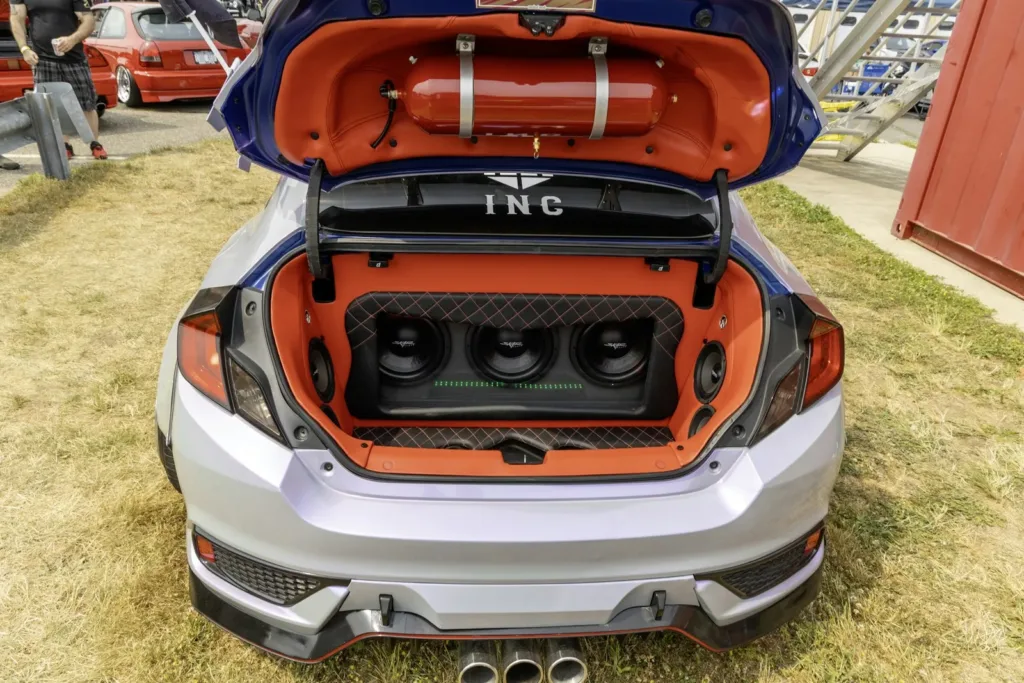
Measured data backs this up. In a trunk test of an 8-inch loaded enclosure in a Honda Accord, output below 40 Hz varied by only about 2 dB across every position and direction tried, while output at 90 Hz differed by more than 20 dB between the best and worst placements (BestCarAudio.com, 2024). The best result came from the trunk corner with the woofer facing the fender and the port facing rearward.
Read the full sedan subwoofer location test if you want the frequency plots. The practical lesson: move the box to fix punch and blend, and change the tuning and filters to fix depth.
Step 6: Use an Enclosure Tuned Low Enough for Deep Bass
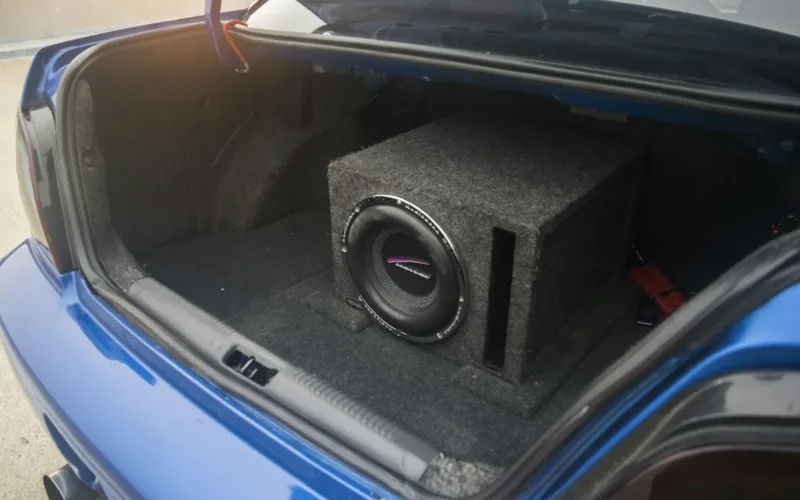
For the deepest bass, use a ported enclosure tuned around 30 to 34 Hz, or a correctly sized sealed box. Ported boxes play 3 to 6 dB louder around their tuning frequency than sealed boxes with the same driver and power (Audio Intensity, 2026), but only down to that tuning point.
Box tuning is the lowest frequency a ported enclosure plays efficiently. Many prefabricated boxes are tuned to 38 to 45 Hz because that sounds impressive in a showroom. That same box rolls off at 24 dB per octave below tuning (Audio Intensity, 2026), so a 45 Hz box has very little left at 30 Hz.
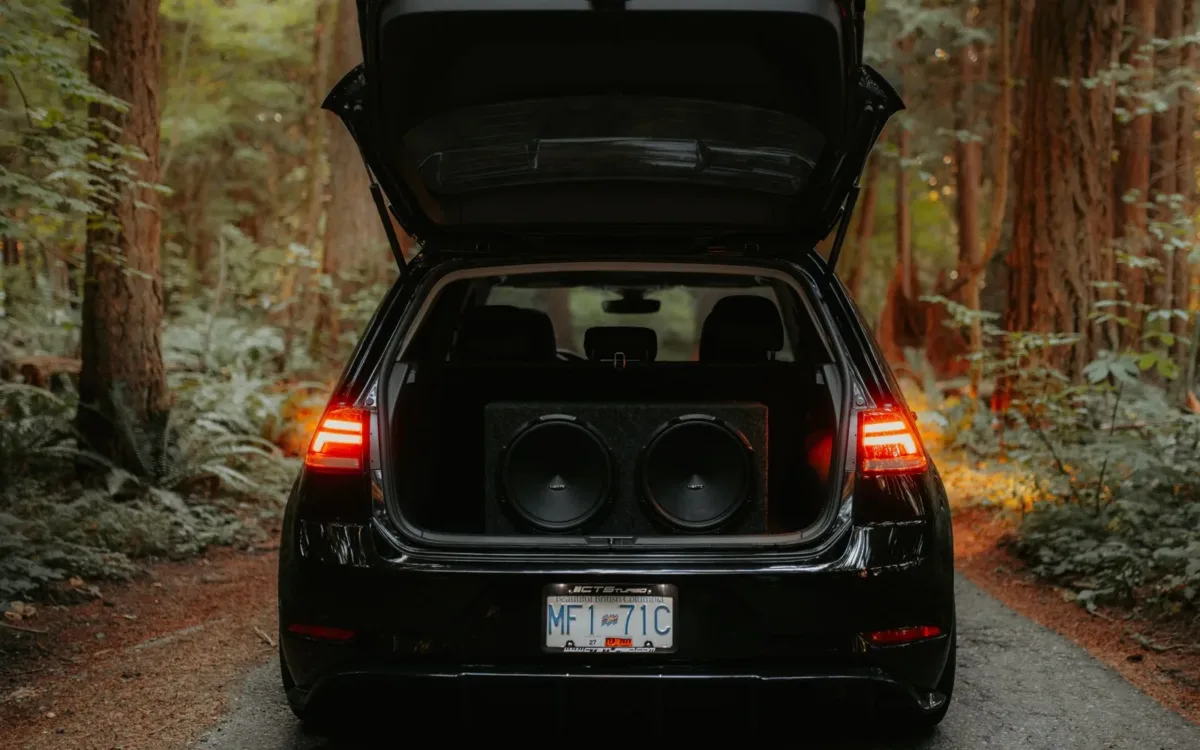
Sealed boxes behave differently in a car. Cabin gain, the pressure build-up inside a small closed space, adds about 12 dB per octave below 70 to 90 Hz depending on the vehicle (CarAudioHelp, 2025). That offsets the sealed box’s 12 dB per octave roll-off, which is why a sealed subwoofer that looks shallow on a spec chart can play surprisingly low in a hatchback.
Is a bigger box better for deep bass?
Up to the manufacturer’s recommended maximum, yes. A slightly larger sealed box lowers the system’s resonant frequency and gives a deeper, softer roll-off. Going beyond the recommended range lets the cone move too freely at high power, so stay within the spec sheet. Our guide on how to choose a subwoofer for your car explains how to match size and box volume to the space you have.
Step 7: Give the Subwoofer Enough Clean Power
Deep bass needs more power than upper bass, because the cone has to move further to make the same volume at lower frequencies. Match the amplifier’s RMS output at your final impedance to the subwoofer’s RMS rating, and choose amplifiers rated to CTA-2006.
That standard measures continuous output into a 4-ohm load at 14.4 volts with no more than 1% total harmonic distortion plus noise (Rockford Fosgate, 2026). An amplifier that meets its CTA-2006 rating can play deep notes cleanly at full output; one with an inflated rating clips first on exactly those notes. Our tested best car amplifiers of 2026 list real output figures.
Check the power and ground wiring
Undersized power wire and a poor ground drop voltage when the amplifier works hardest, which is on long, deep notes. Use a full-gauge wiring kit, fuse it near the battery, and ground to bare metal with a short cable. If your headlights dim on bass notes, the Big 3 upgrade replaces the three main charging cables with heavier ones, commonly 1/0 AWG (Sonic Electronix). See our guide to the best amplifier wiring kits for gauge choices.
Step 8: Remove Rattles and Road Noise That Mask Low Bass
Rattles and road noise hide deep bass, so quieting the car often gives more usable low end than extra watts. A buzzing license plate or trunk lid adds distortion exactly when a deep note plays, and your ear hears the buzz instead of the bass.
Run a slow sine sweep from 20 to 80 Hz and note every rattle. Our guide on how to stop subwoofer vibration in your car covers damping the trunk lid, license plate and panels. If your bass sounds fine parked but thin at highway speed, read why your bass disappears above 50 mph.
Head Unit Settings That Affect Deep Bass
On the head unit, set the EQ flat before tuning, turn off loudness, set any subwoofer level control to its midpoint, and use the highest-quality source you have. These settings feed the amplifier, so a boosted or low-quality signal limits everything downstream.
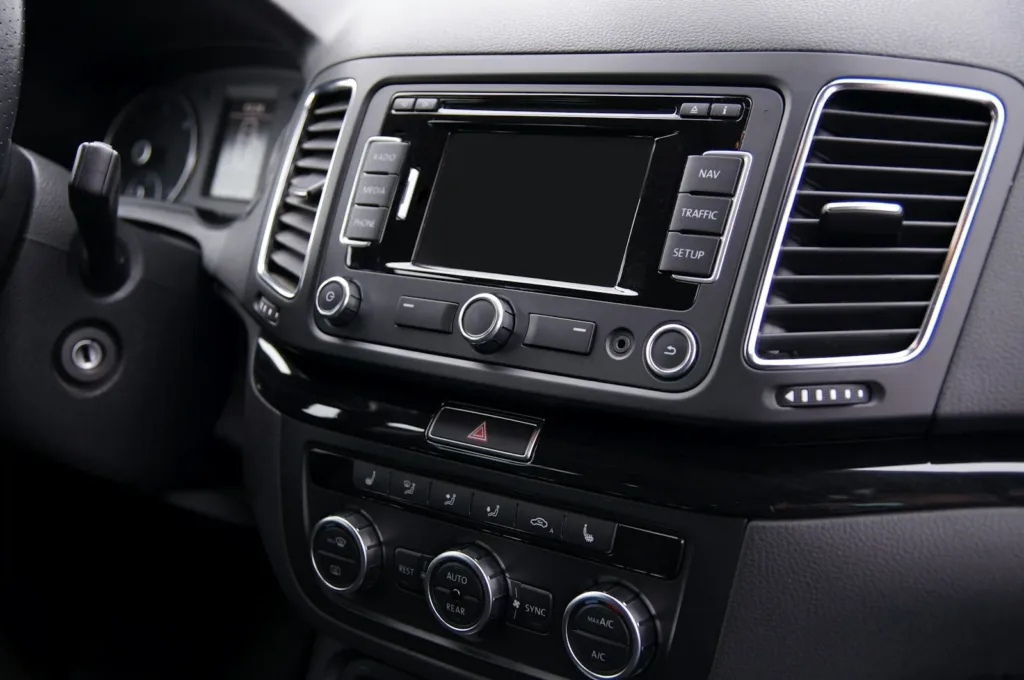
If your head unit has its own subwoofer crossover, use either the head unit’s LPF or the amplifier’s, not both stacked at the same frequency. Two filters in series create a steeper, lower roll-off than either one shows, which can cut upper bass unexpectedly.
Low-bitrate streaming and heavily compressed files lose some low-frequency detail. For tuning, use a lossless file or a high-quality stream, and use test tones from a known source. If you are shopping for a new head unit with better subwoofer controls, see our best car head units of 2026.
How to Test Whether You Actually Have Deeper Bass
Test with a slow sine sweep from 20 to 60 Hz at moderate volume. Listen for the point where the bass fades out, and for any notes that jump out louder than their neighbors. A good deep-bass setup plays smoothly down to the low 30s without obvious peaks.
A phone SPL (sound pressure level) meter app gives a rough comparison between settings, although phone microphones roll off in the deep bass and should not be trusted for absolute readings. Keep the phone in the same spot at the driver’s head position for every test, and change one setting at a time.
Music works as a final check. Pick two or three tracks you know well that have sustained low notes, and listen for depth and control rather than raw volume.
Common Deep Bass Problems and How to Fix Them
| Problem | Likely cause | Fix |
|---|---|---|
| Loud but “one-note” bass | Box tuned too high or bass boost on | Turn off boost; use a box tuned around 30 to 34 Hz |
| Bass sounds like it comes from the trunk | LPF too high or phase wrong | Lower the LPF to 60 to 80 Hz; flip phase |
| Distortion on low notes | Gain too high, amplifier clipping | Reset gain with a test tone and multimeter |
| Little bass below 35 Hz | Subsonic filter set too high | Set it to about 80% of box tuning |
| Bass fades at highway speed | Road noise masking | Sound deaden panels; see our road-noise guide |
| Headlights dim on bass notes | Voltage drop | Upgrade power and ground wiring or do the Big 3 |
If the subwoofer plays weakly no matter what you change, it may be damaged. Our guide on how to fix a subwoofer in your car walks through voice coil and wiring tests.
Frequently Asked Questions About Getting Deep Bass From a Car Subwoofer
What frequency is best for deep bass in a car?
Deep bass sits between about 20 and 40 Hz. For a car subwoofer, set the low-pass filter between 60 and 80 Hz and use an enclosure that plays efficiently down to the low 30s. That combination gives both depth and blend with the door speakers.
Does bass boost make a subwoofer deeper?
No. Bass boost lifts a narrow band, usually around 40 to 45 Hz, and pushes the amplifier toward clipping. It adds volume on a few notes and distortion on the rest. Leave it at zero and use a proper EQ for small, targeted adjustments.
What should I set my subsonic filter to?
For a ported box, set the subsonic filter to about 80% of the tuning frequency, for example 28 Hz for a box tuned to 35 Hz (AudioControl, 2026). For a sealed box, set it low, around 20 to 25 Hz, or turn it off.
Is a sealed or ported box better for deep bass?
A ported box tuned around 30 to 34 Hz gives the most output in the deep-bass range. A sealed box gives slightly less output but extends lower more gradually, and cabin gain in a car helps it. Both can play deep if the box is sized and tuned correctly.
Why does my subwoofer sound deeper outside the car?
Outside, you hear the car body and trunk acting as a large, rattling panel, plus the lower bass that escapes the cabin. Inside, cabin gain and panel cancellation change the balance. Tune for the driver’s seat, not the parking lot.
Will a bigger subwoofer give me deeper bass?
Only if you also have the box volume and amplifier power it needs. A 15-inch subwoofer in a small, high-tuned box sounds less deep than a 12-inch in a correctly sized box tuned low. Fix the settings and enclosure before upgrading the driver.
Summary: Getting Deep Bass From a Car Subwoofer
- Set gain with a test tone and multimeter, and keep bass boost at zero.
- Put the low-pass filter between 60 and 80 Hz and the subsonic filter near 80% of box tuning.
- Use a box tuned around 30 to 34 Hz, or a correctly sized sealed box.
- Feed the subwoofer clean power through proper wiring, then remove the rattles that mask low notes.