TL;DR
- Measure your available space first: the enclosure volume your car can spare decides the subwoofer size, and a 12-inch driver typically needs 1.0 to 1.5 cubic feet sealed.
- A single 12-inch subwoofer is the right choice for most cars. Pick a 10 for tight spaces or fast rock and metal, and a 15 only if you can give up 2.25 cubic feet or more.
- Match the amplifier’s RMS output at your final wired impedance to the subwoofer’s RMS rating, within about 20%, using ratings measured to the CTA-2006 standard.
- Choose a sealed box for accurate bass in a small space, or a ported box for 3 to 6 dB more output near its tuning frequency (Audio Intensity, 2026).
- Check mounting depth, voice coil configuration and your charging system before you pay, because those three decide whether the subwoofer fits and runs properly.
Knowing how to choose a subwoofer for your car comes down to four questions, answered in order: how much space you can give up, how much clean amplifier power you have, what kind of bass you want, and what your electrical system can support. Answer them before you look at a single product page and you will buy the right subwoofer the first time.
This guide walks through each decision with real spec-sheet numbers, so you can compare subwoofers on the figures that change what you hear rather than the ones printed largest on the box.
How to Choose a Subwoofer for Your Car in 7 Steps
To choose a car subwoofer, measure your space, pick a size that fits it, match the RMS power to your amplifier, plan the wired impedance, pick an enclosure type, check the spec sheet, and confirm your electrical system can feed it. Each step narrows the list, so the order matters.
- Measure the space you can give up in the trunk, cab or cargo area, and convert it to cubic feet.
- Pick a driver size (8, 10, 12 or 15 inches) that fits that volume with its recommended enclosure.
- Match the subwoofer’s RMS rating to an amplifier’s RMS output at the impedance you will actually wire.
- Decide between single and dual voice coils based on the final impedance your amplifier handles.
- Choose a sealed, ported or bandpass enclosure based on your music and the space available.
- Check the spec sheet for mounting depth, sensitivity, Xmax and recommended box volume.
- Confirm your alternator, battery and wiring can supply the current the amplifier will draw.
Step 1: Measure the Space Your Car Can Give Up
Start with space, because enclosure volume is the one constraint you cannot work around. Measure the width, depth and height of the area you are willing to lose, multiply them in inches, and divide by 1,728 to get cubic feet. That figure, minus the wall thickness of the box, is your real budget.
A 36 x 16 x 14-inch space, for example, is 8,064 cubic inches, or 4.67 cubic feet gross. Once you subtract 3/4-inch MDF walls on every side, the internal volume drops to roughly 3.9 cubic feet, before the driver and any bracing take their share.
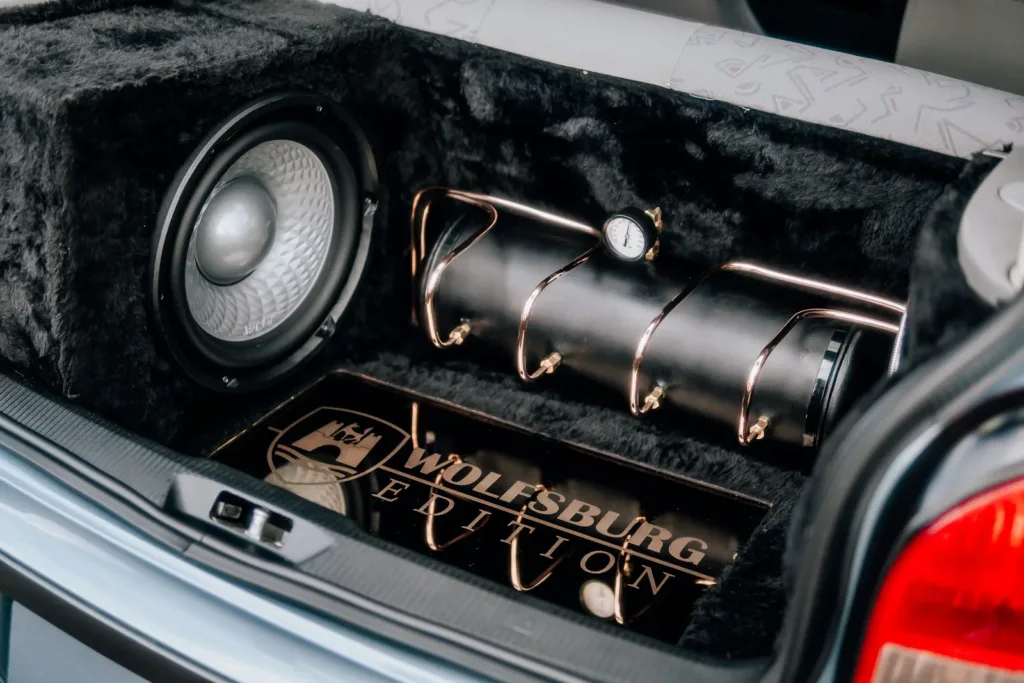
Measure at the narrowest point, not the widest. Wheel wells, trunk hinges, the spare-tire well and a sloping rear seat back all steal space, and a box built to the widest measurement will not go in. Our step-by-step guide on how to measure sub size covers the driver measurements (cutout, mounting depth and overall diameter) you will need once you have a shortlist.
How much space different vehicles usually allow
The table below is a planning starting point. Always confirm with a tape measure in your own car.
| Vehicle type | Space you can usually spare | Realistic subwoofer choice |
|---|---|---|
| Compact car or small hatchback | 0.5 to 1.2 cubic feet | One 8-inch or 10-inch in a sealed box, or a shallow-mount driver |
| Midsize sedan trunk | 1.0 to 3.0 cubic feet | One 10-inch or 12-inch, sealed or ported |
| SUV or wagon cargo area | 2.0 to 5.0 cubic feet | One or two 12-inch, or one 15-inch |
| Regular-cab pickup | 0.3 to 0.8 cubic feet behind the seat | Shallow-mount 8-inch to 12-inch in a thin sealed box |
| Crew-cab pickup | 0.8 to 2.0 cubic feet under the rear seat | One or two shallow-mount 10-inch drivers |
Step 2: Pick the Right Subwoofer Size
Pick the largest subwoofer whose recommended enclosure fits your measured space. For most cars that is one 12-inch driver. A 10-inch driver suits tight spaces and fast music, and a 15-inch driver only makes sense when you can give up 2.25 cubic feet or more for a sealed box.
Size matters because bigger cones move more air. A 12-inch JL Audio 12W3v3 has 520 square centimeters of effective cone area, compared with 345 square centimeters for the 10-inch 10W3v3 (Loudspeaker Database, 2026). That is about 51% more radiating area, which is why a 12 reaches the same low-bass output with less cone travel.
The trade-off is enclosure volume. Here is how one product line scales, using Kicker’s own CompC specifications:
| Size | RMS rating | Cutout diameter | Mounting depth | Recommended sealed box |
|---|---|---|---|---|
| 8-inch CompC | 200 W | 7 in | 3 7/8 in | 0.5 to 1.2 cu ft |
| 10-inch CompC | 250 W | 9 1/8 in | 4 13/16 in | 1.0 to 2.4 cu ft |
| 12-inch CompC | 300 W | 11 in | 5 3/8 in | 1.25 to 3.5 cu ft |
| 15-inch CompC | 600 W | 13 3/4 in | 7 in | 2.25 to 5.0 cu ft |
Source: Kicker CompC 12 specifications and the matching 8, 10 and 15-inch spec pages (Kicker, 2026).
If you are torn between two sizes, our comparison of 10, 12 and 15-inch subwoofers goes deeper on how each one sounds in a real car.
Is a bigger subwoofer always louder?
No. A 15-inch driver in a box half the size it wants will sound weaker and boomier than a 12 in the correct box. Enclosure volume, amplifier power and cone excursion together decide output, so an undersized box cancels the advantage of a larger cone.
Step 3: Match RMS Power to Your Amplifier
Match the amplifier’s RMS output, measured at the impedance you will wire, to the subwoofer’s RMS rating within about 20% either way. A 500-watt RMS subwoofer pairs well with an amplifier delivering 400 to 600 watts RMS at its final load. Ignore peak power entirely.
RMS (root mean square) power is the continuous power a subwoofer can handle, or an amplifier can deliver, over time. Peak power is a short-burst figure and it varies wildly between brands. Kicker, for instance, lists its CompC 12 at 300 watts RMS and 600 watts peak under ANSI/CTA-2031-A (Kicker, 2026), which at least tells you the test method.
For amplifiers, look for a CTA-2006 rating. That standard measures continuous power into a 4-ohm load at 14.4 volts with no more than 1% total harmonic distortion plus noise (Rockford Fosgate, 2026). Amplifiers without a CTA-2006 label often list figures that the hardware cannot sustain.
Why too little power damages subwoofers
An underpowered amplifier is more dangerous than an overpowered one. When you turn up a small amplifier to get more bass, it clips, sending a squared-off signal that heats the voice coil far faster than clean power does. Our reviews of the best car amplifiers and the best budget car amplifiers under $200 list measured output so you can match power properly.
Step 4: Choose Single or Dual Voice Coils and Plan the Final Impedance
Choose the voice coil configuration that lets you wire the subwoofer, or subwoofers, to the lowest impedance your amplifier is stable at. Most mono amplifiers make their most power at 1 or 2 ohms, so a dual voice coil (DVC) driver usually gives you the most wiring options.
A single voice coil (SVC) subwoofer has one pair of terminals and one impedance. A DVC subwoofer has two coils, which you can wire in parallel to halve the impedance or in series to double it. That flexibility is the whole reason DVC drivers are popular; a DVC subwoofer does not sound better than an SVC one.
| Setup | Parallel wiring | Series wiring |
|---|---|---|
| One DVC 4-ohm subwoofer | 2 ohms | 8 ohms |
| One DVC 2-ohm subwoofer | 1 ohm | 4 ohms |
| Two DVC 4-ohm subwoofers | 1 ohm (all parallel) | 4 ohms (series-parallel) |
| Two SVC 4-ohm subwoofers | 2 ohms | 8 ohms |
Check the amplifier’s minimum stable impedance before you buy. Wiring a 1-ohm load to an amplifier rated for 2 ohms will send it into protect mode or shorten its life.
Step 5: Decide Between a Sealed, Ported or Bandpass Enclosure
Choose a sealed enclosure if you want tight, accurate bass from a smaller box, and a ported enclosure if you want more output and have the space. Ported designs produce 3 to 6 dB more output than sealed with the same driver and amplifier around their tuning frequency (Audio Intensity, 2026).
The difference shows up below the tuning point. A sealed box rolls off at 12 dB per octave below resonance, while a ported box drops at 24 dB per octave below its tuning frequency (Audio Intensity, 2026). In a car, cabin gain adds roughly 12 dB per octave below 70 to 90 Hz (CarAudioHelp, 2025), which offsets much of a sealed box’s roll-off and is why sealed subwoofers sound deeper in a car than on a spec chart.
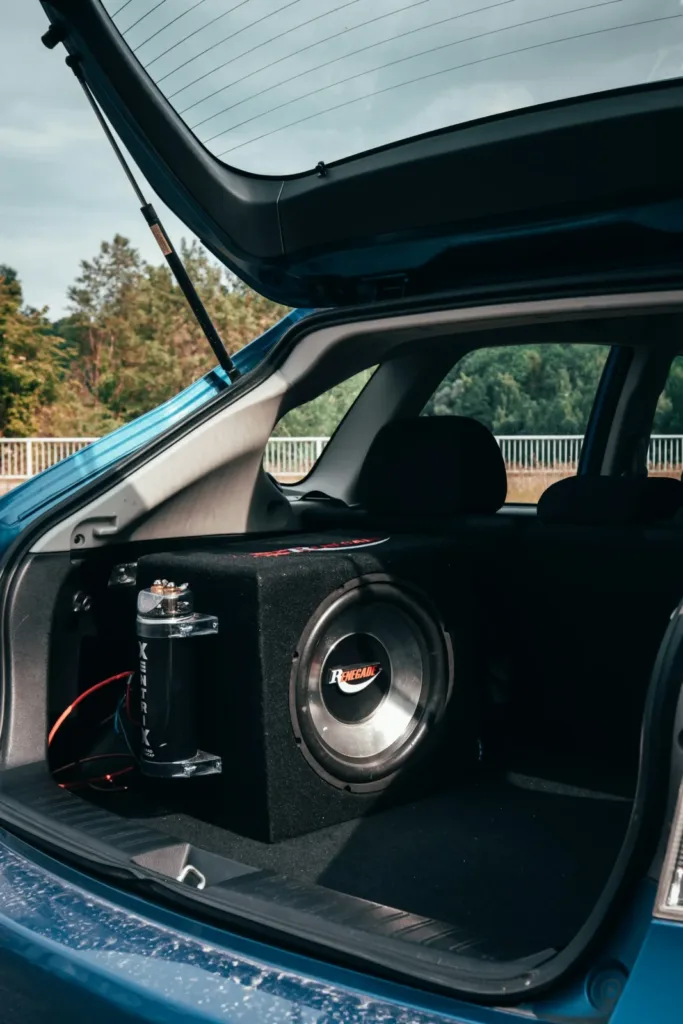
| Enclosure | Best for | Space needed | Sound character |
|---|---|---|---|
| Sealed | Rock, jazz, country, mixed playlists | Smallest | Tight, accurate, gentle roll-off |
| Ported | Hip-hop, EDM, rap, output on a budget | 50% to 80% larger than sealed | Louder near tuning, steep drop below it |
| Bandpass | Maximum output in a narrow band | Large, hard to design | Very loud but narrow, unforgiving |
| Free air | Saving all cargo space | None (uses the trunk) | Weak below 40 Hz, needs a free-air driver |
If deep, low bass is your main goal, the enclosure and tuning choices matter even more. Our guide on how to get deep bass from a car subwoofer covers port tuning, subsonic filters and crossover settings in detail.
Should you buy a loaded enclosure or build your own?
Buy a loaded enclosure (a subwoofer already mounted in a matched box) if you want a guaranteed pairing and a quick install. Buy a component subwoofer and a separate box if you want to choose the exact volume and tuning. A loaded enclosure removes the biggest risk for first-time buyers: putting a good driver in the wrong box.
Step 6: Read the Spec Sheet Numbers That Matter
The spec-sheet numbers that change what you hear are RMS power, sensitivity, recommended enclosure volume, mounting depth, Xmax and the Thiele-Small parameters Fs and Qts. Peak power, magnet weight and cone material marketing tell you very little.
Here is what each number means in practice:
- Sensitivity is the output in decibels at 1 watt and 1 meter. A driver rated 3 dB higher needs half the amplifier power for the same volume, so 87 dB versus 84 dB is a real difference.
- Mounting depth is the distance from the mounting flange to the back of the magnet. The JL Audio 12W3v3-4 needs 6.65 inches, while the Kicker CompC 12 needs 5 3/8 inches (Sonic Electronix, 2026; Kicker, 2026).
- Xmax is the one-way linear cone excursion. More Xmax means more low-bass output before distortion; the JL 10W3v3 is rated at 14 mm (Loudspeaker Database, 2026).
- Fs is the free-air resonant frequency. Lower Fs generally means a driver can play deeper in the right box.
- Qts describes how the driver behaves in a box. Values around 0.4 to 0.7 usually suit sealed boxes, while lower values tend to suit ported ones (Audio Intensity, 2026).
A quick way to combine two of these is the efficiency bandwidth product (EBP), which is Fs divided by Qes. An EBP near 50 or below points to a sealed box, and near 100 or above points to a ported box.
What if your space is too shallow?
If your mounting depth is under about 4 inches, standard drivers will not fit. Look at a dedicated shallow-mount design instead; our roundup of shallow-mount subwoofers for trucks and tight spaces lists the drivers that work behind seats and under floors.
Step 7: Check Your Car’s Electrical System Before You Buy
Before buying a large subwoofer system, confirm your charging system can supply the current. A Class D mono amplifier is roughly 75% efficient (Crutchfield, 2026), so a 500-watt RMS amplifier at full output draws close to 48 amps from a 13.8-volt system. Music averages far less, but peaks still hit the battery.
For a single subwoofer up to about 500 watts RMS on a healthy modern car, the stock charging system is usually fine with the correct wiring. Past that, or if your headlights dim on bass notes, upgrade the three main charging cables first. The Big 3 upgrade replaces the alternator-to-battery positive, the battery-to-chassis ground and the chassis-to-engine ground with heavier cable, commonly 1/0 AWG (Sonic Electronix).
Use a wiring kit rated for your amplifier’s current and fuse it near the battery. Crutchfield’s guide to car amplifier power wire fuses explains that the fuse protects the wire, so it belongs as close to the battery as possible. Our tested picks for an amplifier wiring kit explain what the gauge number really means.
Should You Get One Subwoofer or Two?
Get one good subwoofer unless you have the space, power and charging system for two. Two identical subwoofers, each on the same power as one, play about 6 dB louder than a single driver, but they need twice the enclosure volume and twice the amplifier power to get there.

For most daily drivers, one 12-inch subwoofer in the right box on a properly matched amplifier sounds better than two cheaper subwoofers on an overloaded amplifier. Add the second driver later, once the charging system and enclosure can support it.
How to Match a Subwoofer to Your Music
Match the enclosure and size to what you listen to most. Fast, detailed genres benefit from a sealed 10 or 12, while bass-heavy electronic music and hip-hop reward a ported 12 or 15 with more output below 40 Hz.
| Music you play most | Suggested size | Suggested enclosure |
|---|---|---|
| Rock, metal, punk | 10 or 12-inch | Sealed |
| Jazz, classical, acoustic, country | 10 or 12-inch | Sealed |
| Pop and mixed playlists | 12-inch | Sealed or mildly ported |
| Hip-hop, rap, trap | 12 or 15-inch | Ported, tuned around 32 to 35 Hz |
| EDM, dubstep, bass music | 12 or 15-inch | Ported, tuned low |
These are starting points. A well-built sealed 12 plays hip-hop well, and a ported 12 tuned sensibly handles rock fine.
How to Split Your Budget Across the System
Spend on the amplifier and the enclosure before you spend on an expensive driver. A mid-priced subwoofer in the correct box on clean power beats a premium subwoofer in the wrong box on a clipping amplifier every time.
A sensible split for a first system is roughly 35% on the subwoofer, 35% on the amplifier, 15% on the enclosure and 15% on wiring and installation parts. If you are building the box yourself, move the enclosure share into the amplifier. Our list of the best car subwoofers of 2026 covers six drivers across budget, value and sound-quality price points.
Do not skip a quality wiring kit to save money. Undersized power and ground wire starves the amplifier, and a starved amplifier clips sooner.
Common Mistakes When Choosing a Car Subwoofer
The most common mistakes are buying before measuring, trusting peak power, and ignoring the enclosure. Each one is avoidable if you follow the steps above in order.
- Buying the driver before measuring the space. Mounting depth and box volume are hard limits; measure first, then shop.
- Choosing by peak watts. If a listing leads with peak power and buries the RMS figure, treat every number on it with suspicion.
- Putting a subwoofer in a box it was not designed for. Check the manufacturer’s recommended sealed and ported volumes and stay inside them.
- Wiring below the amplifier’s stable impedance. It may play for a while, then shut down or fail.
- Ignoring rattles. A new subwoofer will find every loose panel in the car. Our guide on how to stop subwoofer vibration in your car shows how to fix them.
- Using the gain knob as a volume control. Set gain once with a test tone and leave it, or you will clip the amplifier and cook the voice coil.
Frequently Asked Questions About Choosing a Car Subwoofer
What size subwoofer is best for a car?
A single 12-inch subwoofer is the best size for most cars. It gives strong low bass from a sealed box of about 1.0 to 1.5 cubic feet. Choose a 10-inch for tight spaces or fast music, and a 15-inch only if you can spare 2.25 cubic feet or more.
How many watts RMS does a car subwoofer need?
A car subwoofer needs an amplifier delivering close to its RMS rating at the final wired impedance, within about 20%. Most single 10 or 12-inch subwoofers are rated between 250 and 600 watts RMS. Match the RMS figures and ignore peak power.
Is a sealed or ported subwoofer better for a car?
A sealed box is better for accurate, tight bass in a small space, and a ported box is better for maximum output. Ported boxes play 3 to 6 dB louder near their tuning frequency but need more space and a correct port length (Audio Intensity, 2026).
What does a dual voice coil subwoofer do?
A dual voice coil subwoofer has two separate coils that you can wire in series or parallel. That lets you change the final impedance, for example 2 or 8 ohms from a dual 4-ohm driver, so you can match the load your amplifier handles best.
Can I install a car subwoofer myself?
Yes. A single subwoofer, a mono amplifier and a wiring kit is a three to four hour job for a first-timer with basic tools. The steps that need the most care are fusing the power wire near the battery and grounding the amplifier to bare metal.
Do I need a new head unit to add a subwoofer?
No. A factory stereo works with a subwoofer through a line output converter or an amplifier with high-level inputs. An aftermarket head unit with preamp outputs and a subwoofer level control gives cleaner signal and easier adjustment, but it is optional.
How do I know if a subwoofer will fit my car?
Compare three numbers against your car: the recommended enclosure volume against your measured space, the mounting depth against the depth available behind the baffle, and the overall box dimensions against the narrowest opening, such as the trunk lid or rear-seat pass-through.
Quick Recap: Choosing the Right Car Subwoofer
- Measure the space in cubic feet before you shortlist anything, and measure at the narrowest point.
- Pick one 12-inch driver unless space or music points to a 10 or a 15.
- Match amplifier RMS at the final impedance to subwoofer RMS within about 20%, using CTA-2006 ratings.
- Choose sealed for accuracy and small boxes, ported for extra output when you have the room.
- Confirm mounting depth, wiring impedance and charging capacity before you pay.