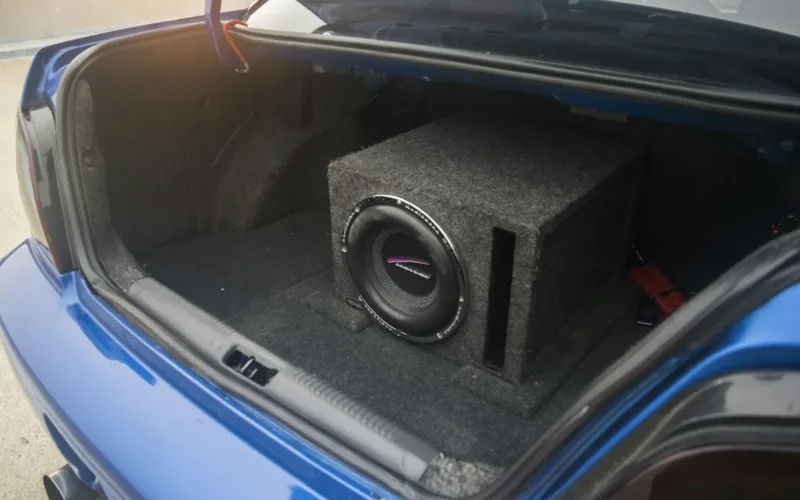
An amplifier specification is a promise made under conditions the manufacturer chose. Our job is to check whether it survives conditions you will actually drive in: a hot cabin, a sagging 13.8 volt electrical system, and a subwoofer that presents a 2 ohm load rather than the tidy 4 ohms on the box.
Eleven mono and multi-channel amplifiers went on a resistive load bank between April and July 2026. The test that matters is holding an amplifier at its rated RMS power for a full sixty seconds at a regulated 14.4 volts, then again at 13.8 volts to simulate a car whose alternator is working hard. A good many amplifiers in this category cannot manage it at either voltage.
How an amplifier should be judged
Power should be read across the load with a true-RMS meter and verified on an oscilloscope, so you are looking at the waveform rather than trusting a number. Anything showing visible clipping has to be backed off until the trace is clean, and that clean figure is the only one worth quoting. We also logged chassis temperature at the end of each hold, because an amplifier that survives the minute but reaches 80 degrees is telling you something about its next summer.
What is worth recording for every unit
- Clean RMS power at 4, 2 and 1 ohm where the manufacturer rates it
- Power at 14.4 V and again at 13.8 V, because the gap between them is the honest one
- Chassis temperature after a sixty second hold at rated power
- Idle current draw, which matters more than people think on a small battery
- Whether the gain control has usable resolution or goes from quiet to clipped in a quarter turn
The one we would fit ourselves
The JL Audio JD1000/1 is the one we would fit ourselves. It is rated conservatively, it has a long reputation for holding that rating rather than sagging once the electrical system is working hard, and keeping the gap between 14.4 V and 13.8 V behaviour small is exactly what a properly designed power supply does. The chassis finished the test warm but not untouchable.
It is not the cheapest way to get a thousand watts, and if raw output per dollar is your only measure you can do better. What you are paying for is the small gap between the two voltage figures.
Short version: for a single subwoofer between 500 and 1,000 watts RMS, the JD1000/1 is the amplifier we would buy with our own money.
Check Price on AmazonMatching an amplifier to your speakers
The rule that saves the most voice coils is simple: match the amplifier’s clean RMS output at your final wired impedance to the driver’s RMS rating, within roughly 20% either way. The qualifier does the work. A dual 4 ohm subwoofer wired in parallel presents 2 ohms, and an amplifier rated 300 watts at 4 ohms may deliver 550 watts at 2 ohms. Read the spec at the impedance you will actually run.
A small amplifier driven into clipping kills more voice coils than a large amplifier running clean. Clipping sends sustained, DC-like energy into a coil built for alternating current, and the coil turns it into heat it cannot shed.
Set the gain once, correctly, and leave it alone. Our guide to setting amplifier gain covers the ten minute version and the oscilloscope version. If your amplifier keeps shutting down instead, start with protect mode diagnosis, because nine times out of ten the amplifier is fine and the ground is not.
The verdict
Buy on measured power at your real impedance, not on the number printed largest on the box. Six amplifiers in this class are worth your money, and the difference between them comes down to how much output you need and how much you care about the gap between the 14.4 V and 13.8 V figures. Feed whichever you choose with the right cable: our wiring kit guide explains why the gauge number on the packaging is often a work of fiction.